

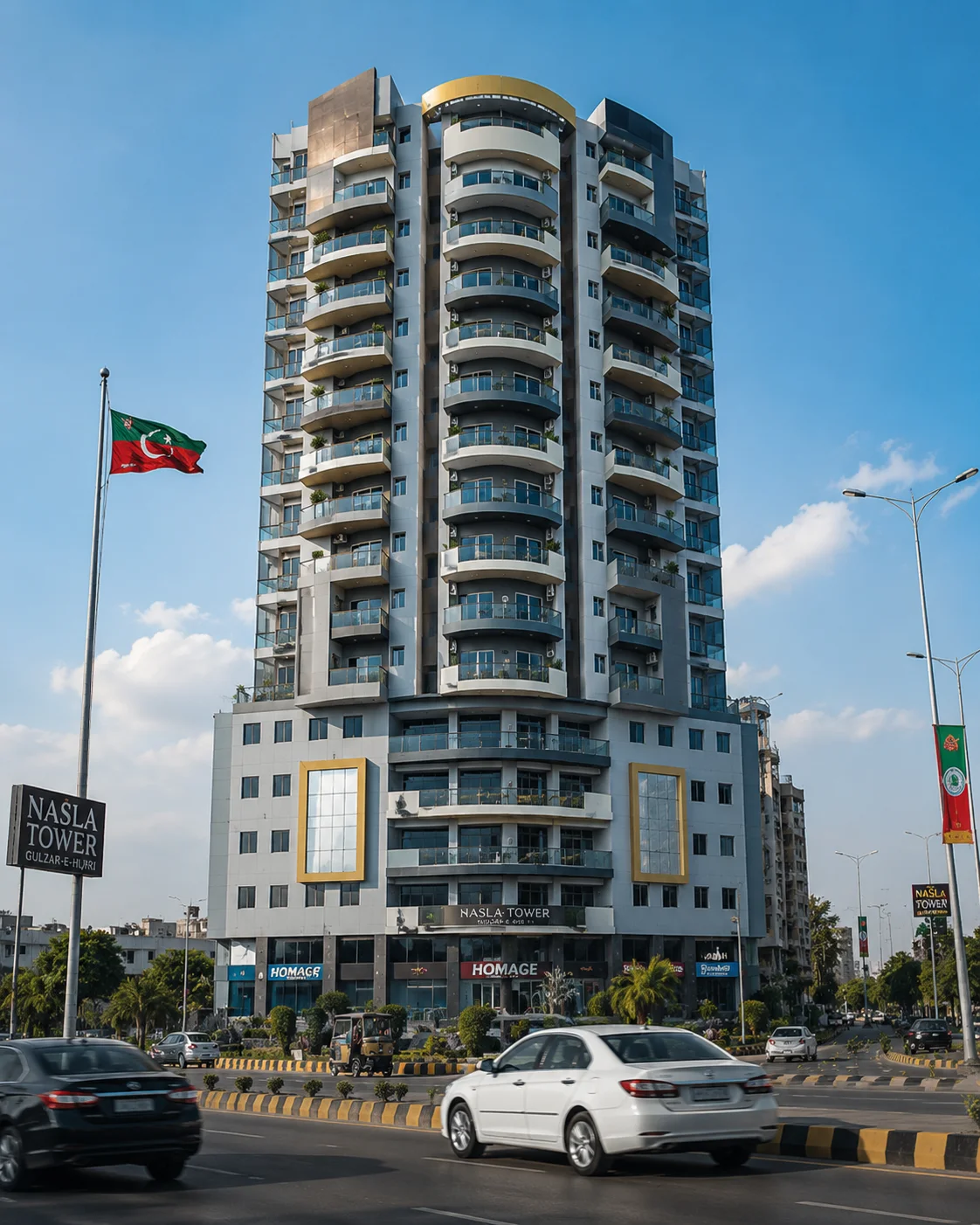
Karachi Illegal Buildings Case: FCC Recalls Supreme Court Demolition Orders
The Karachi Illegal Buildings Case has taken a significant legal turn after the Federal Constitutional Court (FCC) recalled a series of Supreme Court orders that had led to the demolition of several allegedly illegal buildings across Karachi, including the well-known Nasla Tower. The ruling concludes that while action against unlawful construction remains important, enforcing building laws is primarily the responsibility of the provincial government and its regulatory authorities rather than the judiciary.
The judgment, delivered by a two-member FCC bench headed by Justice Aamer Farooq, revisited Supreme Court directives issued in 2018 and 2019 that expanded into a citywide campaign against illegal constructions. According to the court, those broader orders exceeded the issues originally before the Supreme Court and did not sufficiently follow the legal requirement of due process for affected property owners.
FCC Says Building Law Enforcement Belongs to the Government
In its judgment, the Federal Constitutional Court stated that regulating and enforcing building laws falls within the constitutional authority of the Sindh government and its relevant departments, including the Sindh Building Control Authority (SBCA).
The court acknowledged that the Supreme Court’s intention to address illegal construction in Karachi was aimed at improving governance and protecting public interests. However, it concluded that courts should not replace executive authorities in carrying out regulatory responsibilities.
The FCC emphasized that every case involving alleged illegal construction must be handled through the legal procedures established under existing laws. It said demolition orders cannot be issued solely on the basis of reports submitted by the SBCA without ensuring that affected parties receive due process.
Case Originated From a Lyari Building Dispute
The legal proceedings originally began with a dispute over the construction of a multi-storey building in Mussa Lane, Lyari.
In November 2016, the Sindh High Court directed the SBCA to demolish the building after finding it unlawful. The building owner challenged that decision before the Supreme Court, where the appeal remained under consideration from 2017 onward.
During the hearings, the Supreme Court also examined broader concerns about illegal constructions in Karachi. Over time, the proceedings expanded well beyond the original appeal and resulted in several orders concerning allegedly unauthorized buildings throughout the city.
Supreme Court Orders Expanded Into Citywide Demolition Drive
According to the FCC judgment, a major shift occurred in July 2018 when the Supreme Court requested a comprehensive record of buildings constructed in Lyari without approved building plans.
Later, on December 21, 2018, the court observed that alleged illegal construction was not limited to Lyari but had spread across Karachi. It directed the SBCA to initiate action against officials allegedly involved in permitting or facilitating unauthorized developments.
The following month, on January 22, 2019, the Supreme Court issued wider directions concerning commercial structures built in Jam Sadiq Ali Park. Authorities were instructed to remove marriage halls, shopping centres, markets and other structures that had allegedly violated the city’s approved planning framework.
The court also instructed provincial authorities to restore Karachi according to its original master plan and prevent future deviations.
Nasla Tower Demolition Followed Earlier Orders
The FCC noted that these Supreme Court directions eventually resulted in extensive enforcement operations across Karachi.
Among the most prominent outcomes was the demolition of Nasla Tower, a 15-storey residential building located on Shahrah-e-Faisal, which became one of the most high-profile examples of the anti-illegal construction campaign.
Numerous other buildings also became subject to legal proceedings or enforcement action during the following years.
Builders and Property Owners Challenged the Orders
Between 2019 and 2025, several individuals and organizations, including the Association of Builders and Developers (ABAD), approached the Supreme Court seeking to intervene in the ongoing proceedings.
Following the establishment of the Federal Constitutional Court under the 27th Constitutional Amendment, these pending matters were transferred to the FCC for consideration.
The court observed that what began as an appeal concerning one building had gradually transformed into broader judicial supervision over urban planning and anti-encroachment efforts across Karachi.
FCC Criticises Expansion Beyond Original Legal Dispute
Justice Aamer Farooq wrote that courts must generally remain focused on resolving the legal dispute placed before them.
According to the judgment, the Supreme Court’s broader directions concerning illegal buildings across Karachi were not necessary for deciding the original appeal relating to the Lyari property.
The FCC referred to this expansion as an exercise resembling “continuous mandamus,” where judicial oversight extended into executive functions.
The court concluded that such an approach did not meet the legal standard required for resolving the actual controversy before the bench.
Illegal Construction Still Remains Unlawful
Despite recalling the earlier Supreme Court directives, the FCC made it clear that its ruling should not be interpreted as legalizing unauthorized buildings.
The judgment stressed that Pakistan already has an established legal framework governing building regulations, planning approvals and enforcement mechanisms.
The Sindh government, SBCA and other relevant authorities remain responsible for investigating alleged violations and taking lawful action wherever necessary.
The court emphasized that enforcement must occur strictly in accordance with constitutional protections and applicable laws.
Earlier Supreme Court Orders Officially Withdrawn
As part of its ruling, the Federal Constitutional Court formally recalled the Supreme Court orders issued on December 21, 2018 and January 22, 2019.
The judgment also withdrew related directions, reports, proceedings and enforcement actions that were based on those specific judicial orders or remained pending under them.
The decision effectively ends the broader judicial framework established during those earlier proceedings while leaving future enforcement responsibilities with provincial authorities.
Additional Note Highlights Citizens’ Rights
In a separate note attached to the judgment, Justice Syed Arshad Hussain Shah highlighted the importance of protecting citizens’ constitutional rights.
He stated that Karachi residents are entitled to public facilities such as parks, playgrounds, green belts, footpaths, pedestrian areas, beaches, libraries, educational institutions, healthcare facilities and other civic amenities.
According to the additional note, these public spaces form an essential part of the constitutional rights to life and human dignity.
Justice Shah further stated that such public assets must be protected from unlawful encroachments, misuse or unauthorized conversion. Any changes to approved master plans, he noted, must occur strictly in accordance with the Constitution and applicable laws.
He also called upon all relevant government departments and local authorities to preserve these public amenities for current and future generations.
Why the Judgment Matters
The FCC’s decision marks an important clarification regarding the constitutional separation of powers in Pakistan.
While reaffirming that illegal construction should be addressed, the court concluded that the responsibility for regulating buildings and enforcing planning laws rests primarily with provincial authorities rather than the judiciary.
The ruling may influence how future cases involving urban planning, encroachments and unauthorized construction are handled, particularly where questions arise over the limits of judicial intervention versus executive responsibility.
Source:
- Dawn
Our audience means everything to us.
Have feedback or suggestions to make us better? We’re always listening—feel free to get in touch with us at editor@truthorahub.com








Leave a Comment