

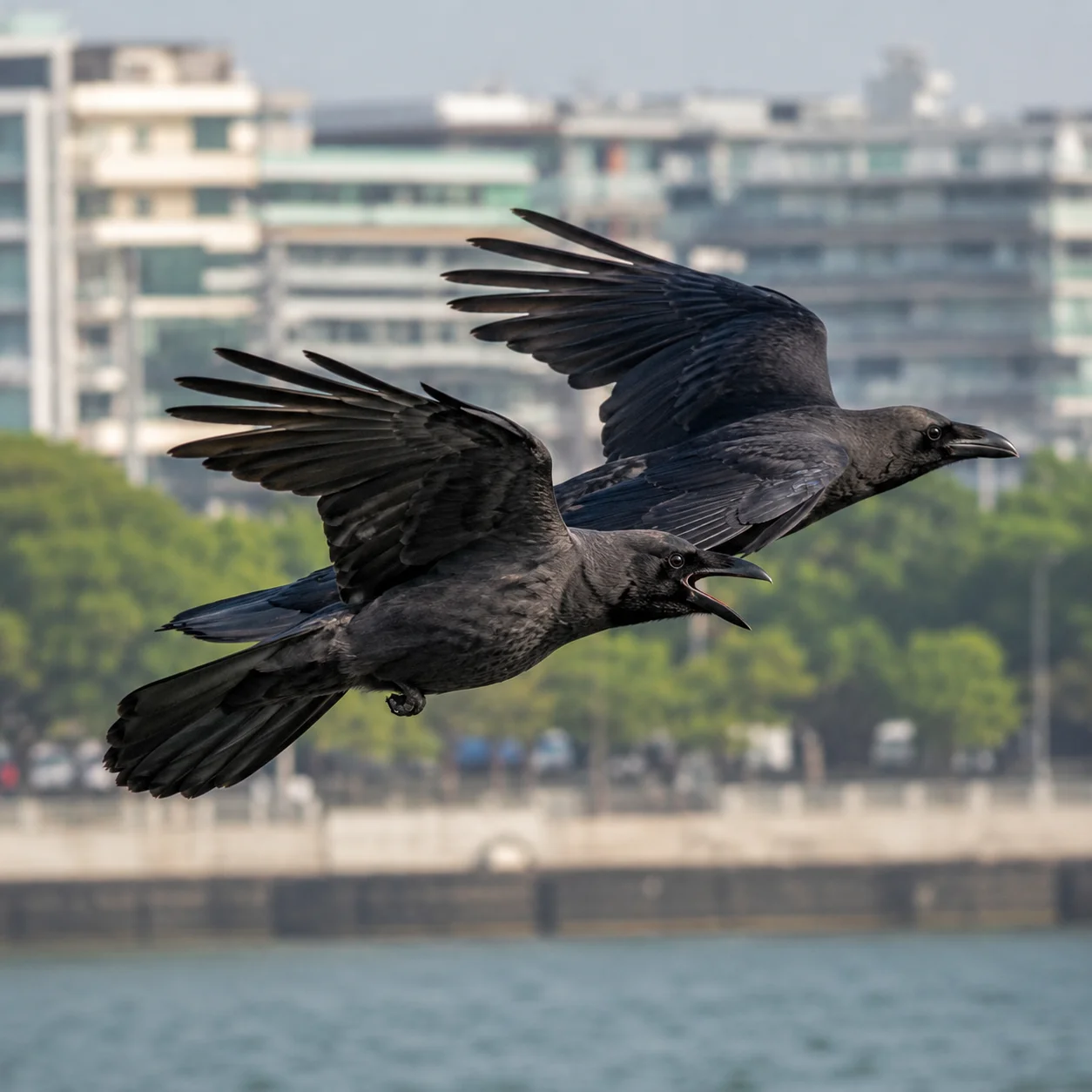
What Are Crows Really Saying to Each Other?
For centuries, humans have watched crows with curiosity. Their intelligence, social behavior, and mysterious calls have sparked endless questions. But what if those sounds are more than random noises? What if crows are actually having detailed conversations?
Scientists in Spain believe we may finally be close to finding out.
Researchers studying carrion crows are now using artificial intelligence to decode bird communication in ways that were impossible just a few years ago. And the results are already changing how we understand animal intelligence, cooperation, and even emotions.
This fascinating project has attracted global attention, with reports and discussions appearing on platforms connected to wildlife research and conservation journalism. Experts say this breakthrough could transform the future of animal communication studies.
Why Carrion Crows Fascinate Scientists
The focus of this groundbreaking research is the carrion crow, scientifically known as Carrion Crow. These birds are not ordinary backyard crows. They are known for their highly organized social systems and surprisingly advanced teamwork.
Unlike many bird species where only parents care for chicks, carrion crows practice “cooperative breeding.” Entire family groups help raise babies, protect nests, and gather food. This level of coordination suggests a very complex communication system.
Professor Vittorio Baglione and Professor Daniela Canestrari from the University of León have spent decades trying to understand exactly how these birds coordinate their actions.
The real mystery was never whether crows communicate. Scientists already knew they do. The bigger question was: How detailed is that communication?
Could crows warn each other about danger? Share information about food? Coordinate defense strategies? Comfort family members? Or even argue?
Researchers believe the answers may lie hidden inside thousands of crow vocalizations.
The Problem: Too Much Data, Too Little Time
Studying crow communication sounds exciting, but it quickly became overwhelming.
Researchers placed microphones and biologging devices across northern Spain to capture bird calls and monitor behavior. The devices worked nonstop for nearly a week at a time.
Soon, scientists were drowning in recordings.
Thousands upon thousands of audio clips piled up faster than humans could analyze them. Listening manually to every sound became nearly impossible.
This is where artificial intelligence entered the story.
In 2024, the researchers partnered with the Earth Species Project, a nonprofit organization focused on using AI to understand animal communication.
Their goal sounds almost futuristic: build technology capable of identifying patterns, structures, and possible meanings in animal sounds.
And surprisingly, it is already working.
AI Is Detecting Hidden Patterns Humans Missed
Using advanced AI models, scientists have now identified more than 127,000 crow vocalizations.
That number alone is staggering.
The technology can separate adult crow calls from baby crow sounds. It can even distinguish crow calls from other bird species nearby.
But perhaps the most important breakthrough is synchronization.
Imagine several crows calling at the same time from different locations. Previously, researchers struggled to match who was speaking and what each bird was doing.
Now AI helps synchronize recordings from multiple devices, allowing scientists to observe real-time “dialogues” between birds.
This has revealed something unexpected.
Most crow communication is not loud cawing.
Instead, researchers discovered that many crow sounds are actually soft, quiet murmurs used at close range. Scientists believe this suggests a large amount of communication happens privately within families rather than through long-distance calls.
That discovery alone challenges years of assumptions about bird communication.
Are Animals More Intelligent Than Humans Assumed?
This research raises a difficult but exciting question.
Have humans underestimated animal intelligence for centuries?
Scientists increasingly believe many animals possess highly structured social systems and possibly forms of language that humans simply never understood.
According to researchers, communication may offer a window into the emotional and social lives of animals.
Could animals discuss danger, relationships, cooperation, or even feelings in their own ways?
AI is helping scientists investigate these questions much faster than before.
Previously, analyzing years of recordings could take months or even decades. Machine learning models can now process massive audio collections in hours.
This technological leap is revolutionizing wildlife research.
It’s Not Just About Crows Anymore
The same technology is now being used underwater.
Researchers at the Raincoast Conservation Foundation are working with AI experts to study Orca communication.
Orcas, often called killer whales, live in extremely tight-knit family groups and are known for their coordinated hunting strategies. Scientists already know they use distinct vocal calls, but the meaning behind those sounds remains largely unknown.
Using underwater microphones, drones, and AI-powered analysis tools, scientists are now attempting to connect specific whale calls with behaviors and environmental conditions.
This could help researchers understand how orcas cooperate while hunting, traveling, or protecting their families.
But there’s another major concern.
Human-made underwater noise.
The Hidden Threat Beneath the Ocean
Modern oceans are becoming louder every year.
Cargo ships, military sonar systems, industrial drilling, and marine traffic create enormous levels of underwater noise pollution.
Scientists fear this noise may interfere with how whales communicate.
Imagine trying to hold a conversation in the middle of a construction site. That may be what marine animals experience daily.
Researchers believe decoding whale communication could help conservationists better understand how human noise affects animal behavior and survival.
AI is already helping by filtering enormous amounts of ocean audio. Instead of manually listening to every recording, scientists can now instantly isolate whale vocalizations.
What once took months now takes hours.
This speed allows researchers to focus more on understanding behavior instead of sorting data.
Could Humans One Day Talk to Animals?
This is the question capturing public imagination worldwide.
Movies, social media discussions, and online debates often suggest AI might someday allow humans to “talk” with animals directly.
But scientists are urging caution.
Experts involved in the research say the goal is not to create conversations between humans and animals like science fiction films.
Instead, the mission is understanding animals on their own terms.
Researchers warn against forcing human ideas of language onto species with completely different ways of experiencing the world.
Still, the possibility remains thrilling.
What if AI eventually identifies emotional patterns? Warnings? Requests? Social bonds?
Even partial understanding could completely reshape humanity’s relationship with nature.
Why This Research Matters More Than Ever
The world is currently facing a biodiversity crisis.
Species are disappearing at alarming rates due to climate change, habitat destruction, pollution, and hunting.
Scientists believe understanding animal communication may strengthen human empathy toward wildlife.
When people recognize animals as socially intelligent beings with intricate relationships and communication systems, conservation efforts often gain stronger public support.
In simple terms, humans protect what they emotionally connect with.
And hearing the hidden conversations of nature could change how society views wildlife forever.
AI and Wildlife: A Powerful New Partnership
Artificial intelligence is already transforming industries across the globe. But its role in wildlife conservation may become one of its most meaningful applications.
From forests in Spain to oceans in Canada, AI is helping scientists uncover secrets that once seemed impossible to study.
The technology is not replacing researchers. Instead, it is giving them superhuman analytical power.
Scientists can now process enormous datasets, identify communication patterns, and compare behaviors with unprecedented speed.
This partnership between biology and technology may define the future of conservation science.
What Happens Next?
Researchers are now building detailed “semantic maps” that combine:
- Audio recordings
- Video footage
- Movement data from tracking devices
- Environmental conditions
- Behavioral observations
The goal is to match specific calls with specific actions and situations.
For example:
- Does one sound signal danger?
- Do parents use different calls with babies?
- Can crows identify individual family members through sound?
- Do whales use unique vocal patterns during hunting?
These are the questions scientists hope AI can help answer.
And while full translation of animal language may still be far away, experts say humanity has already entered a new era of wildlife research.
A New Way of Listening to Nature
Perhaps the most remarkable part of this story is not the technology itself.
It is the reminder that humans are surrounded by forms of communication we barely understand.
Every forest, coastline, and ocean may contain conversations happening constantly beyond human awareness.
For decades, those voices remained hidden inside endless recordings and complex sound patterns.
Now, artificial intelligence is finally helping scientists listen.
And for the first time in history, humanity may slowly begin to understand what the animal world has been saying all along.
Source:
Primary reporting and interview information published by Mongabay and supported by research collaborations involving the Earth Species Project and the University of León
Have feedback or suggestions to make us better? We’re always listening—feel free to get in touch with us at truthora2026@gmail.com









Leave a Comment