


How a Simple Name Confusion Turned Into a Viral Internet Story
In today’s fast-moving digital world, a single post can travel across thousands of screens within minutes. While social media has made information more accessible than ever, it has also increased the chances of misinformation spreading at lightning speed.
A recent incident involving Pakistani actor and influencer Romaisa Khan highlights exactly how quickly online confusion can escalate.
The actress found herself unexpectedly trending on social media after several pages and media outlets mistakenly linked her to a viral altercation that allegedly took place between two women at a cafe in Karachi’s DHA area. The confusion emerged because one of the individuals reportedly involved shared the same first name.
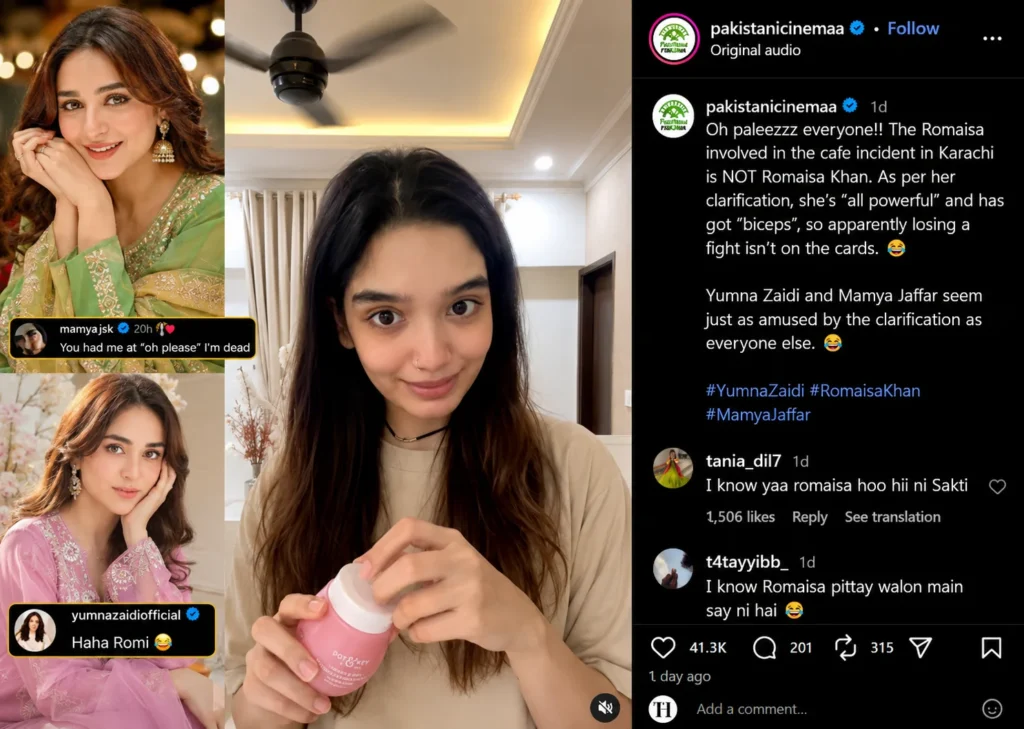
What followed was not outrage or legal threats, but a humorous response that won the internet’s approval.
Romaisa addressed the situation through a lighthearted Instagram video, clarifying that she had absolutely no connection to the incident. Her witty remarks quickly gained attention, turning an uncomfortable misunderstanding into a viral moment that many social media users appreciated.
But beyond the jokes and memes, the incident has also sparked an important discussion about misinformation, digital responsibility, and the challenges public figures face in the social media age.
What Actually Happened?
The controversy began when reports about a viral altercation circulating online started appearing on social media pages and entertainment platforms.
However, some accounts mistakenly used photographs of Romaisa Khan while discussing the incident.
As the posts spread, many users naturally assumed the actress was directly involved.
The situation became more confusing as screenshots and reposts multiplied across different platforms.
For many celebrities, being incorrectly linked to a controversial story can quickly become a public relations challenge.
Romaisa, however, chose a different approach.
Instead of reacting angrily, she decided to address the matter with humor.
Romaisa Khan’s Viral Response Wins Hearts
After noticing her photographs being used in connection with the story, Romaisa took to Instagram to set the record straight.
In a video that quickly gained traction online, she jokingly addressed the confusion and laughed at the absurdity of the situation.
She humorously remarked that she woke up only to discover that she had apparently become involved in a fight she knew nothing about.
The actress even joked about reports suggesting she had “lost” the altercation, adding a playful twist that immediately resonated with her followers.
Her comedic delivery transformed what could have become a negative news cycle into an entertaining and relatable moment.
Within hours, clips from her response began circulating across multiple social media platforms.
The Importance of One Name, Many People
One of the key points Romaisa highlighted was something surprisingly simple.
Many people share the same name.
In an era where information spreads instantly, assumptions can often replace facts.
The actress reminded followers that she is not the only Romaisa in Pakistan—or in the world.
While her statement was delivered humorously, it carried an important message.
Public figures are often vulnerable to mistaken identity online, especially when users share information without verification.
The incident serves as a reminder that names alone are not enough to identify individuals involved in news stories.
Verification remains essential.
When Photos Are Used Incorrectly
Perhaps the most concerning aspect of the incident involved the unauthorized use of Romaisa’s photographs.
According to her, several pages and publications used her images alongside stories about the altercation despite having no evidence connecting her to the event.
She revealed that some outlets only removed the content after she personally commented and pointed out the mistake.
This raises an important question:
How often are images used without proper verification?
In the race for clicks, engagement, and viral reach, some social media pages may prioritize speed over accuracy.
Unfortunately, such mistakes can have real consequences for the individuals involved.
For public figures whose careers depend heavily on reputation, even temporary misinformation can create unnecessary challenges.
Why Social Media Misinformation Spreads So Quickly
The Romaisa Khan incident is not unique.
Every day, social media users encounter misleading headlines, edited images, and inaccurate claims.
But why does misinformation spread so rapidly?
One major reason is speed.
People often share content before reading the full story.
Others repost information based solely on a headline or image.
Algorithms can further amplify viral content regardless of whether it is accurate.
The result is a cycle where incorrect information reaches thousands of people before corrections can catch up.
Experts frequently warn that digital literacy is becoming increasingly important in the modern information landscape.
Learning how to verify sources and cross-check information is no longer just a skill for journalists—it is becoming a necessity for everyone.
Fans Praise Her Positive Attitude
One reason Romaisa’s response resonated with so many people was her positive attitude.
Instead of responding with frustration, she used humor to diffuse the situation.
Many fans praised her maturity and confidence.
Comments flooded social media platforms, with users applauding the actress for handling the misunderstanding gracefully.
Some described her response as refreshing.
Others noted that her ability to laugh at the situation made the correction more effective than a confrontational response might have been.
In many ways, her reaction became more viral than the original confusion itself.
The Reality of Being a Public Figure in the Digital Age
For celebrities and influencers, social media offers tremendous opportunities.
It allows direct communication with audiences, personal branding, and instant engagement.
However, it also comes with unique challenges.
False reports, edited content, mistaken identities, and online rumors have become increasingly common.
A single inaccurate post can quickly gain momentum before facts emerge.
Many public figures have faced similar situations over the years, finding themselves linked to stories, controversies, or statements they had no connection to.
The Romaisa Khan episode highlights the importance of maintaining a direct relationship with followers.
Because she had an established audience, she was able to clarify the misunderstanding quickly and effectively.
A Gentle Message Against Fake News
Despite the jokes and laughter, Romaisa ended her response with a serious message.
She politely requested that people avoid involving her in incidents she had nothing to do with.
Her remarks reflected a broader issue affecting social media platforms worldwide.
Misinformation does not only impact celebrities.
It can affect ordinary individuals, businesses, organizations, and entire communities.
False information can damage reputations, create confusion, and sometimes even lead to real-world consequences.
This is why responsible sharing remains so important.
Before posting, commenting, or reposting content, users should consider whether the information has been verified.
A few extra seconds of fact-checking can prevent unnecessary misunderstandings.
Romaisa Khan’s Growing Career
While the viral misunderstanding attracted attention, many fans also used the opportunity to celebrate Romaisa’s ongoing success in the entertainment industry.
The actress continues to build her profile through television dramas, digital content, and social media engagement.
She is currently appearing in the drama serial Dekh Zara Pyar Se, where she plays the character Warisha.
Her performance has helped strengthen her presence within Pakistan’s television industry.
Many viewers also remember her from Jinn Ki Shadi Unki Shadi, where her comedic timing earned praise from audiences and helped expand her fan base.
Her ability to balance acting and social media influence has made her one of the notable young personalities in Pakistan’s entertainment landscape.
What Can We Learn From This Incident?
The story may appear lighthearted, but it offers several valuable lessons.
First, names can be shared by multiple people.
Second, photographs should never be used without proper verification.
Third, social media users should think carefully before sharing information.
And finally, responding with grace and humor can sometimes be more powerful than responding with anger.
Romaisa Khan’s reaction transformed a potentially damaging misunderstanding into an opportunity for awareness, laughter, and discussion.
Conclusion
The recent mix-up involving Romaisa Khan demonstrates how quickly misinformation can spread in today’s digital environment. What started as a case of mistaken identity soon turned into a viral online conversation, drawing attention to the importance of fact-checking and responsible reporting.
Fortunately, Romaisa handled the situation with humor, confidence, and professionalism. Her response not only corrected the record but also reminded audiences about the dangers of making assumptions online.
As social media continues to shape how news travels, stories like this serve as an important reminder: not everything that trends is true, and sometimes a simple name confusion can become a nationwide talking point.
For Romaisa Khan, the incident may have started with confusion, but it ultimately ended with widespread support, positive engagement, and an even stronger connection with her audience.
Source:
Public statements by Romaisa Khan via Instagram, entertainment media reports, and social media coverage of the Karachi cafe incident.
Our audience means everything to us.
Have feedback or suggestions to make us better? We’re always listening—feel free to get in touch with us at truthora2026@gmail.com





Leave a Comment