

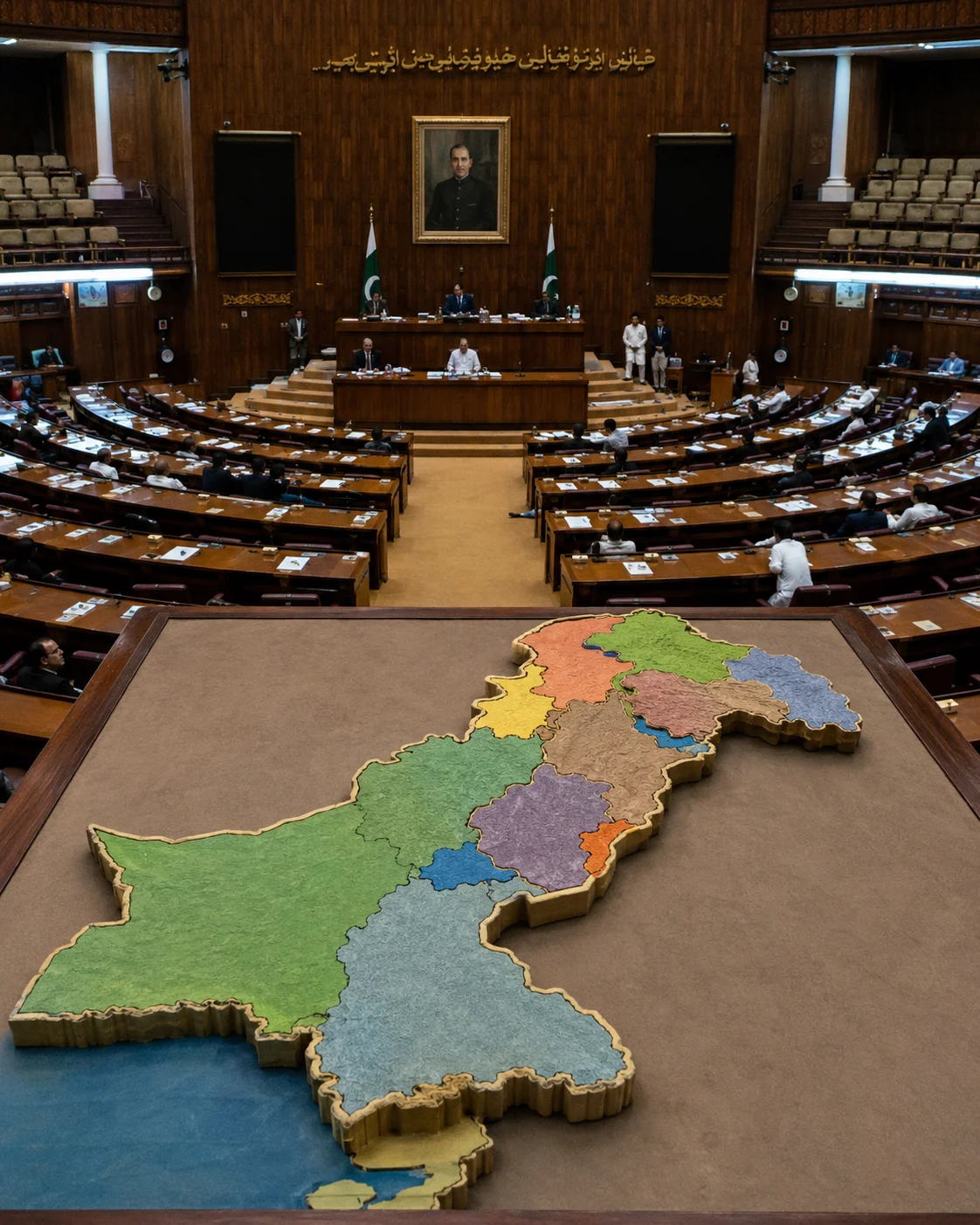
The debate over new provinces in Pakistan has once again come under discussion, but representatives of several major political parties have favoured strengthening local governments rather than creating additional provinces to address governance and service-delivery problems.
The views emerged during a day-long discussion organised by the Sustainable Development Policy Institute (SDPI) in Islamabad on whether Pakistan needs new provinces or other administrative units. Participants acknowledged weaknesses in the existing governance structure, but differed over whether those problems could be solved by redrawing provincial boundaries.
Representatives of the PML-N, PPP, PTI and JUI opposed the creation of additional provinces during the discussion, while MQM-P representatives supported the idea. Several independent experts also argued that political, administrative and financial authority should be transferred more directly to elected local governments.
The discussion also highlighted concerns about bureaucracy, public spending, constitutional procedures and the financial cost of establishing additional provincial governments.
New provinces in Pakistan versus stronger local governments
A central argument raised during the discussion was that Pakistan’s governance problems are not necessarily caused by a shortage of resources or an insufficient number of provinces.
Instead, participants said excessive concentration of decision-making powers in provincial capitals has limited the ability of governments to deliver services effectively at the local level.
PTI Secretary General Salman Akram Raja argued that existing administrative units could already provide a foundation for improving service delivery if local governments were given greater authority.
Raja also questioned whether dividing Punjab into three provinces would solve the underlying governance problem, arguing that each proposed province would still have a very large population.
He called for Article 140-A of the Constitution, which concerns local government, to be strengthened and for greater constitutional protection for local institutions.
The PTI leader also rejected the idea of holding a national referendum on the creation of new provinces, arguing that the Constitution already provides a mechanism for changing provincial boundaries.
Political parties divided over administrative restructuring
Although several major political parties opposed new provinces at the discussion, the issue remains politically significant and has attracted different positions from various parties and leaders.
PML-N Minister of State for Law Barrister Aqeel Malik said political parties should first hold internal discussions before the country considers constitutional or legal changes relating to new provinces.
He also pointed to the local government structure introduced in 2001, arguing that it was stronger and should have been developed further rather than abandoned.
PPP leader Qamar Zaman Kaira warned that the issue could deepen existing political and regional divisions if handled without consensus.
Kaira argued that Pakistan already faces several political and institutional challenges and that creating smaller administrative units should not become a substitute for addressing the country’s broader governance problems.
He also opposed a national referendum, saying the Constitution already establishes a procedure for creating new provinces.
MQM-P supports creation of new provinces
MQM-P representatives took a different position during the discussion and supported the creation of additional provinces.
MNA Aasia Ishaq argued that the existing governance structure had failed to adequately serve the public and criticised political leadership for the situation.
Federal Minister for Health Mustafa Kamal also raised the issue of provincial control over financial resources, focusing on the share received by provinces through the National Finance Commission.
The MQM-P position reflects the party’s longstanding emphasis on greater administrative and political decentralisation, particularly for densely populated urban areas.
However, support for additional provinces was not limited to MQM-P representatives.
Media executive Mian Amir also argued for a much larger number of provinces, proposing that Pakistan could eventually have 32 provinces. His argument was based on the idea that smaller administrative units could bring government resources and decision-making closer to citizens.
That proposal, however, contrasts with the position of most political representatives at the SDPI discussion, who favoured strengthening local governments instead.
Experts question the financial cost of new provinces
A major concern raised against the creation of new provinces was the financial burden involved.
Creating a province would require a range of new administrative institutions, including provincial-level offices and other government structures. Critics of the proposal argued that these additional institutions could increase expenditure without necessarily improving services.
Financial analyst Dr Farrukh Saleem said creating more provinces would not automatically generate additional fiscal space. He argued that Pakistan’s taxpayers already face a significant burden and that establishing additional civilian administrative structures would increase government costs.
Saleem proposed removing the provincial tier altogether and creating stronger local governments based on existing administrative units.
His argument was that the country could achieve greater administrative decentralisation without creating multiple new provincial governments.
Bureaucracy blamed for weak service delivery
The discussion also featured strong criticism of Pakistan’s bureaucracy.
JUI-F MNA Noor Alam Khan argued that the existing system has failed partly because of weaknesses within the bureaucracy. He supported stronger local governments and warned that additional provinces could create disputes between regions over resources.
Journalist Mohammad Malick similarly argued that bureaucratic performance should receive greater attention in discussions about governance failures.
Other participants called for more technically qualified officials to be placed in important government positions.
Former finance ministry adviser Dr Khaqan Hasan Najeeb said governance could improve if administrative posts were filled by people with relevant technical expertise rather than relying primarily on a generalist model.
These views reflected a broader argument made during the discussion: changing administrative boundaries alone may not solve problems involving institutional capacity, accountability and public-sector performance.
Article 140-A emerges as key reform proposal
Article 140-A became an important part of the discussion because it provides the constitutional basis for local governments.
Several participants argued that the provision needs to be strengthened so that local governments can exercise meaningful political, administrative and financial authority.
Dr Khaqan Hasan Najeeb proposed increasing local government spending substantially, suggesting that the share could rise from around 4.7% to 40% of government budgets.
He also suggested creating a Reorganisation Commission to examine whether new provinces are actually required and, if so, how administrative restructuring should be approached.
The proposal reflects the broader position that Pakistan should first examine the performance and financing of its existing governance system before creating additional layers of administration.
Constitutional hurdles remain
The creation of new provinces would also require significant constitutional changes.
Barrister Muhammad Ali Saif, an adviser to the Khyber Pakhtunkhwa chief minister, said any decision on new provinces should be based on political consensus.
He noted that changes would affect several constitutional provisions, including those dealing with the creation of provinces, representation in Parliament, the judiciary and the distribution of financial resources.
He also proposed establishing a national commission to examine the question of new provinces.
The Constitution sets out a specific process for altering provincial boundaries. Any such proposal therefore involves more than an administrative decision and would require compliance with the relevant constitutional provisions.
Participants also stressed the importance of political consensus before attempting structural changes to the federation.
Some participants still support smaller provinces
Despite the broad preference among major parties for stronger local government, several participants argued that smaller provinces could still have a role in improving administration.
Mian Amir advocated a much larger number of provinces, while MQM-P representatives supported the creation of additional administrative units.
Barrister Saif also said there was a case for new provinces, but stressed that the process should be accompanied by genuine devolution of authority to local governments.
This position reflects a middle ground: creating smaller provinces may address some administrative concerns, but it would not necessarily solve problems at the grassroots level unless local institutions are also empowered.
Concerns over political and regional tensions
Opponents of rapid administrative restructuring warned that the creation of new provinces could intensify disputes over resources, political representation and regional identity.
PPP leader Qamar Zaman Kaira said Pakistan already faces multiple challenges and warned against replacing existing provincial divisions with smaller forms of regional nationalism.
Other participants called for broad political agreement before any major changes are attempted.
Former federal minister Fawad Chaudhry cautioned against making fundamental constitutional changes hastily, arguing that major structural reforms require political consensus.
The discussion therefore highlighted that the question of new provinces is not purely administrative. It also involves constitutional, political, financial and regional considerations.
Debate follows renewed calls for new provinces
The SDPI discussion comes amid renewed public and political debate over whether Pakistan’s four-province structure remains suitable for its growing population and changing administrative needs.
Supporters of smaller provinces argue that government would become more accessible and administrative areas would become easier to manage.
Opponents counter that creating additional provincial governments could increase expenditure while leaving the underlying problem of weak local institutions unresolved.
The debate has also been fuelled by criticism of Pakistan’s existing service-delivery system and the concentration of authority at provincial capitals.
Recent public discussions have similarly focused on whether stronger local governments could provide a less costly route to decentralisation. The SDPI has previously hosted discussions involving politicians and experts with differing views on administrative restructuring.
Local governments remain central to the debate
For many participants, the key issue was not simply the number of provinces but where political, administrative and financial power should ultimately reside.
Supporters of stronger local governments argue that citizens interact most directly with municipal and district institutions over services such as sanitation, local infrastructure and other community-level matters.
Giving those institutions adequate authority and resources could, in their view, reduce the dependence of citizens on provincial capitals.
The debate over new provinces in Pakistan is therefore closely connected to the broader question of decentralisation.
For now, there appears to be no consensus among political stakeholders on creating additional provinces. The strongest common ground at the SDPI discussion was the need to improve governance and bring public services closer to citizens, although participants disagreed on whether that should be achieved through new provinces, stronger local governments or a combination of both.
Source:
- Sustainable Development Policy Institute (SDPI) — background on its discussions concerning administrative restructuring and the creation of new provinces.
- Associated Press of Pakistan (APP) — reporting on SDPI discussions involving political representatives and experts on new provinces and local government.
- Dawn — background reporting and analysis on the debate over new provinces and the role of empowered local governments.
Our audience means everything to us.
Have feedback or suggestions to make us better? We’re always listening—feel free to get in touch with us at editor@truthorahub.com




Leave a Comment