

Pakistan’s Car Market Is Changing Fast — But What Does It Mean for Buyers?
For years, Pakistan’s automobile industry revolved around three major Japanese brands. Whether someone wanted a small hatchback, a family sedan, or a reliable commercial vehicle, the names remained almost the same: Pak Suzuki, Honda Atlas, and Indus Motor Company. These companies dominated roads, dealerships, and consumer trust for decades.
But now, something unusual is happening.
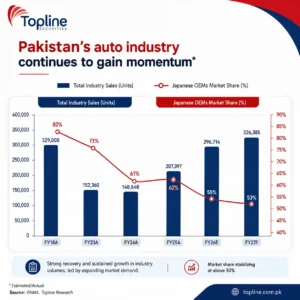
The grip of traditional automakers is slowly weakening as new competitors enter the market with aggressive pricing, modern technology, and vehicles designed for changing consumer needs. According to industry projections, Pakistan’s auto sector is expected to continue its recovery in fiscal year 2025-26, with total vehicle sales likely to reach nearly 297,000 units.
At first glance, that sounds like a strong comeback story.
Yet behind the numbers lies a bigger shift — one that could permanently reshape Pakistan’s automotive future.
Auto Sales Recovering After Years of Economic Pressure
Pakistan’s auto sector has faced a difficult journey over the last few years. Political instability, rising inflation, import restrictions, currency depreciation, and high interest rates severely affected car sales across the country.
Consumers delayed purchases. Banks reduced auto financing. Manufacturers struggled with parts shortages. Many factories temporarily halted production due to supply chain issues.
However, recent projections suggest the market is gradually stabilizing again.
Industry analysts estimate that total vehicle sales in FY2025-26 — including local manufacturers, non-PAMA assemblers, and imported used cars — may climb close to 297,000 units. This would bring the market near the record sales levels seen before Pakistan’s economic slowdown.
Financial brokerage firm Topline Securities believes the recovery trend is likely to continue as economic conditions improve and consumer confidence slowly returns.
But the recovery is not unfolding in the same way as before.
Japanese Brands Still Lead — But Their Dominance Is Shrinking
Despite remaining market leaders, Japanese automakers are no longer enjoying the overwhelming control they once had.
According to projections, Indus Motor Company, Honda Atlas Cars, and Pak Suzuki Motor Company are expected to collectively hold around 56 percent market share in FY26.
That may still sound significant, but compare it to FY18, when these companies controlled nearly 80 percent of Pakistan’s auto market during peak industry volumes of approximately 329,000 units.
The decline highlights a major transformation in consumer behavior and market competition.
For decades, Japanese brands benefited from strong dealership networks, trusted resale value, and limited competition. Buyers often had little choice outside these established manufacturers.
Today, that reality is changing rapidly.
Why Are Consumers Looking Beyond Traditional Brands?
One major reason is affordability.
With inflation hitting household budgets hard, many consumers are now searching for vehicles that provide better value for money. New entrants are targeting exactly this gap by introducing affordable crossovers, compact SUVs, and feature-rich vehicles at competitive prices.
Modern buyers are also becoming more aware of technology, fuel efficiency, and safety features.
Questions that were once ignored are now becoming central:
- Does the car offer advanced infotainment?
- How fuel-efficient is the engine?
- Are airbags and safety features included?
- Is the design modern enough?
- Does the price justify the features?
Many newer automotive companies are capitalizing on these changing preferences.
Instead of relying purely on brand loyalty, they are focusing on innovation and aggressive pricing strategies.
Chinese Automakers Are Quietly Reshaping Pakistan’s Roads
One of the biggest developments in Pakistan’s automotive landscape is the growing influence of Chinese-backed automobile brands.
Over the past few years, several new companies have entered the local market through partnerships and joint ventures. Their arrival has significantly increased competition.
Unlike older manufacturers that relied heavily on conventional sedans and hatchbacks, many new entrants introduced SUVs and crossover vehicles that appeal to younger buyers and middle-income families.
Consumers who once dreamed of owning expensive imported SUVs are now finding relatively affordable alternatives assembled locally.
This trend is not only changing purchasing habits but also redefining expectations within the industry.
Experts believe this competition could ultimately benefit Pakistani consumers through:
- Better vehicle quality
- Improved safety standards
- More pricing options
- Faster technological upgrades
- Greater customer service competition
The Rise of Non-PAMA Players
Another major shift is the increasing contribution of non-PAMA assemblers.
Traditionally, Pakistan Automotive Manufacturers Association (PAMA) members dominated industry sales statistics. But non-PAMA companies are now gaining traction by targeting market segments previously ignored by mainstream players.
These companies are expanding rapidly in urban centers where consumers are more open to experimenting with newer brands.
Many buyers, especially younger professionals, are prioritizing features and affordability over traditional brand names.
This changing mindset is slowly eroding the long-standing monopoly enjoyed by established automakers.
Used Imported Cars Still Play a Major Role
Imported used vehicles continue to influence Pakistan’s auto market as well.
Even though regulatory policies fluctuate, imported cars remain attractive to many buyers due to:
- Better build quality
- Advanced features
- Hybrid technology
- Fuel efficiency
Japanese used imports, particularly hybrid models, continue to maintain strong demand in cities like Karachi, Lahore, and Islamabad.
For some consumers, buying a slightly older imported vehicle still feels more valuable than purchasing a locally assembled car with fewer features.
This competition adds additional pressure on local manufacturers to improve quality standards and pricing structures.
Is Pakistan Finally Becoming a Competitive Auto Market?
For years, critics argued that Pakistan’s auto industry lacked genuine competition.
Consumers often faced:
- Long delivery times
- High prices
- Limited innovation
- Outdated designs
- Poor customer experience
Now, however, market conditions appear to be evolving.
As more companies enter the industry, automakers are being forced to compete harder for customer attention.
This competition could reshape the sector in several important ways:
- Faster model upgrades
- More feature-packed vehicles
- Improved manufacturing quality
- Better financing options
- Greater emphasis on after-sales service
If this trend continues, Pakistan’s automobile industry may finally begin operating more like competitive global markets.
Economic Stability Will Still Decide the Industry’s Future
While recovery projections are encouraging, challenges remain.
Pakistan’s automobile sector remains highly sensitive to:
- Currency fluctuations
- Interest rates
- Government taxes
- Import policies
- Fuel prices
Any major economic instability could slow demand once again.
Auto financing, in particular, plays a crucial role in vehicle sales. If interest rates remain high, many middle-class consumers may continue postponing purchases.
Similarly, import restrictions on auto parts could still disrupt production schedules.
Industry experts say sustainable growth will depend heavily on consistent economic policies and long-term investor confidence.
What Should Buyers Expect in FY2025-26?
For consumers, the coming year may offer more choices than ever before.
Competition is increasing. Vehicle categories are expanding. Automakers are experimenting with newer designs and technologies.
Buyers could soon see:
- More hybrid options
- Additional crossover SUVs
- Better safety features
- Competitive financing offers
- Improved fuel efficiency
At the same time, traditional Japanese brands are unlikely to surrender market share easily.
Companies like Pak Suzuki, Honda Atlas, and Toyota-backed Indus Motor still enjoy strong brand trust and nationwide service networks. They continue to hold significant advantages in resale value and customer loyalty.
However, the days of near-total market dominance appear to be fading.
A Turning Point for Pakistan’s Automobile Industry
Pakistan’s auto market is entering one of the most important transition periods in its history.
The projected recovery in FY2025-26 is not simply about rising sales numbers. It reflects deeper structural changes happening across the industry.
Consumers are becoming smarter.
Competition is becoming tougher.
And automakers are being pushed to evolve.
The era when a few companies controlled almost the entire market may finally be coming to an end.
For Pakistani car buyers, that could mean something the market has long lacked:
Real choice.
Source:
Topline Securities, industry projections, market analysis reports, automotive sector data
Our audience means everything to us.
Have feedback or suggestions to make us better? We’re always listening—feel free to get in touch with us at ayesha@linen-rat-910062.hostingersite.com




Leave a Comment