

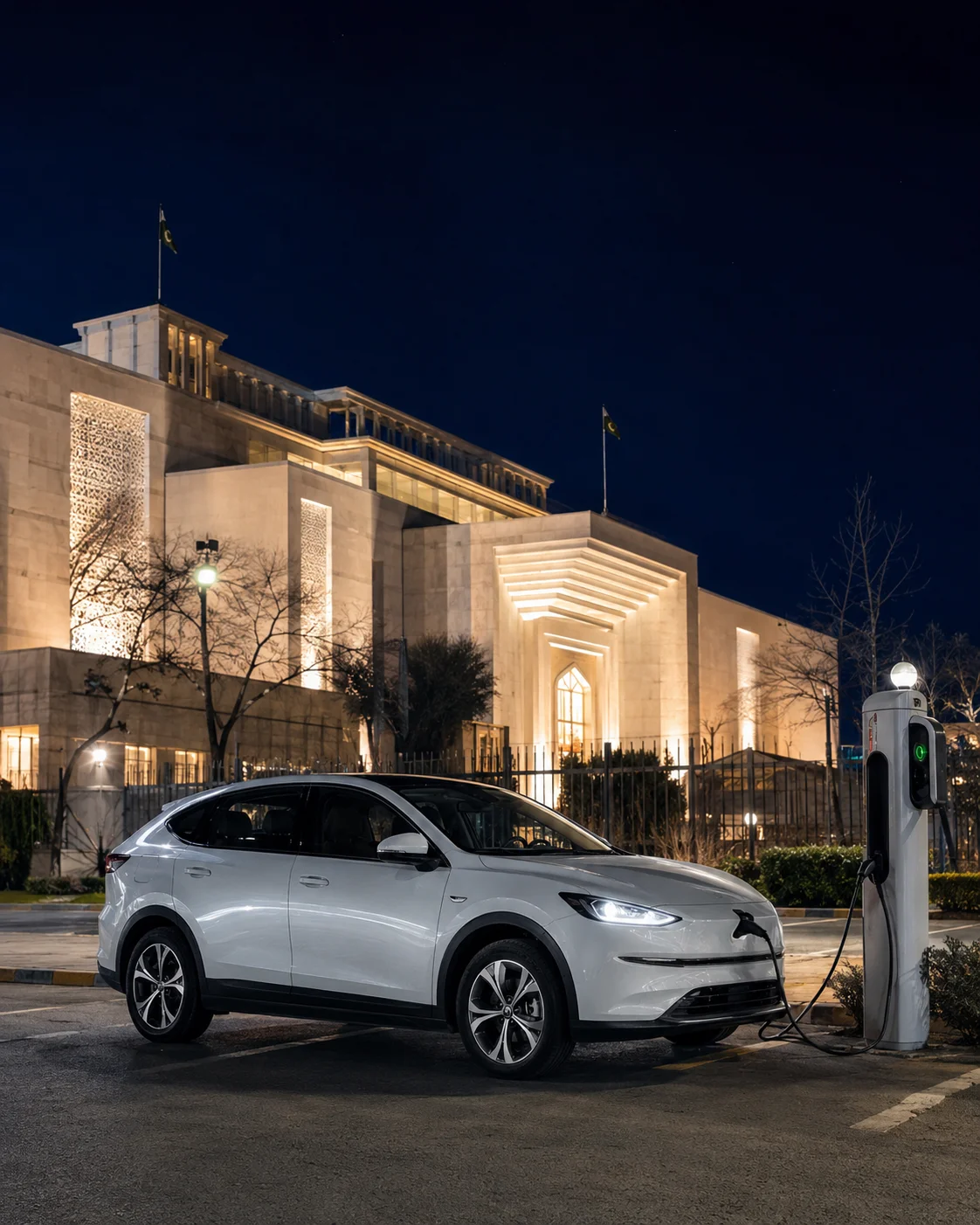
Pakistan Auto Policy 2026 Delayed as Government Reviews EV Incentives
Pakistan Auto Policy 2026 has been delayed after the federal government decided to restart the drafting process following concerns raised by local automobile manufacturers over proposed incentives for electric vehicles (EVs). The move comes after the previous five-year automotive policy expired at the end of June, creating uncertainty over tax concessions for hybrid vehicles and delaying the introduction of a new regulatory framework for the country’s automotive sector.
The government is now expected to prepare a revised policy that balances the promotion of electric mobility with the interests of Pakistan’s existing automobile manufacturing industry.
Government Restarts Auto Policy Process
The Ministry of Industries and Production had prepared a draft of the proposed Auto Policy 2026-31 after consulting stakeholders from the automotive sector.
According to the available information, one of the central objectives of the draft policy was to accelerate the adoption of electric vehicles in Pakistan. Policymakers viewed the shift toward EVs as a way to reduce the country’s heavy reliance on imported petroleum products, particularly following concerns over energy security during regional tensions involving the United States and Iran.
Pakistan imports nearly 80% of its petroleum products to meet domestic demand, making fuel imports a major burden on the country’s economy.
However, the proposed policy reportedly prompted concerns among established automobile manufacturers, who requested Prime Minister Shehbaz Sharif to review the draft before its approval.
As a result, the draft policy was not finalized, and the government has reportedly formed a new committee to prepare a revised version.
Delay Comes After Previous Policy Expired
The postponement has created immediate challenges for the automotive industry because the Auto Industry Development and Export Policy 2021-26 officially expired on June 30, 2026.
Without a replacement policy being notified, previous tax incentives automatically lapsed.
As a consequence, the Federal Board of Revenue (FBR) restored the standard 25% General Sales Tax (GST) on hybrid electric vehicles (HEVs) and plug-in hybrid electric vehicles (PHEVs) from July 1, 2026.
Previously, hybrid vehicles had benefited from a reduced GST rate of 8.5%.
The higher tax rate has significantly increased the cost of hybrid vehicles in Pakistan.
Hybrid Vehicle Prices Increase
The restoration of the higher GST has had an immediate impact on consumers and vehicle manufacturers.
Toyota and Honda have increased prices for several hybrid models, with some vehicles becoming more than Rs1.3 million more expensive.
The uncertainty surrounding the new policy has also affected business operations. Some automobile manufacturers reportedly paused invoicing and vehicle deliveries while awaiting clarity on the government’s future taxation and incentive structure.
Industry observers say prolonged uncertainty could affect both consumer demand and investment decisions across Pakistan’s automotive market.
Deputy Prime Minister Assigned to Prepare New Draft
According to the reported developments, Prime Minister Shehbaz Sharif has assigned Deputy Prime Minister Ishaq Dar to oversee the preparation of a revised Auto Policy 2026-31.
The government’s objective is expected to be the development of a policy that supports the transition toward cleaner transportation while addressing the concerns of existing manufacturers and component suppliers.
No official timeline has yet been announced for the completion or approval of the revised policy.
Industry Supports EV Transition but Seeks Gradual Implementation
Industry representatives have emphasized that they are not opposed to electric vehicles themselves.
The Pakistan Association of Automotive Parts & Accessories Manufacturers (Paapam) has stated that Pakistan should move toward electric mobility but believes the transition should be gradual and supported by local industrial development.
The association has proposed introducing a balanced taxation framework, including an 18% GST on hybrid vehicles, until Pakistan develops sufficient EV charging infrastructure and domestic manufacturing capabilities.
Industry representatives argue that a phased transition would provide manufacturers and suppliers with adequate time to adapt to new technologies while protecting existing investments.
Focus on Local Manufacturing and Technology Transfer
Paapam has also urged policymakers to make local manufacturing a central part of the country’s EV strategy.
Among its recommendations are:
Increase Localisation Targets
The association wants EV incentives to be linked with annual increases in locally manufactured components rather than relying heavily on imported vehicle kits.
Develop Domestic EV Components
Industry representatives have proposed encouraging local production of key EV components, including:
- Batteries
- Electric motors
- Electronic control systems
They also recommend promoting technology transfer agreements that would allow Pakistani manufacturers to build expertise in electric vehicle production.
Support Existing Manufacturers
Paapam has suggested providing assistance to existing automotive parts manufacturers so they can modernize factories and transition toward producing EV components.
The association has also requested equal opportunities for established automobile manufacturers wishing to introduce electric and hybrid vehicle models.
Concerns Over Employment and Investment
Industry representatives have warned that offering extensive incentives for imported EVs without a structured transition plan could negatively affect Pakistan’s existing automotive ecosystem.
According to their concerns, excessive incentives for imported electric vehicle kits could reduce demand for locally manufactured components, place existing investments at risk, and impact employment within Pakistan’s automotive parts industry.
The association believes future policy should strike a balance between encouraging cleaner transportation and protecting domestic manufacturing capacity.
Why the New Policy Matters
Pakistan’s automotive sector is entering a period of significant change as governments around the world encourage the adoption of electric vehicles to reduce fuel consumption and lower emissions.
For Pakistan, the transition carries additional economic importance because the country spends substantial foreign exchange on importing petroleum products.
At the same time, policymakers face the challenge of protecting an established automobile manufacturing sector that supports thousands of jobs and a large network of local parts suppliers.
The revised Pakistan Auto Policy 2026 is therefore expected to play a key role in determining how quickly electric vehicles are introduced while ensuring the long-term sustainability of domestic manufacturing.
Until the government finalizes the new policy, uncertainty is likely to continue for manufacturers, suppliers, dealerships, and consumers awaiting clarity on future tax rates, incentives, and investment plans.
Source:
- Ministry of Industries and Production (as referenced in the provided information)
- Federal Board of Revenue (FBR)
- Pakistan Association of Automotive Parts & Accessories Manufacturers (Paapam)
- Information provided in the source article
Our audience means everything to us.
Have feedback or suggestions to make us better? We’re always listening—feel free to get in touch with us at editor@truthorahub.com



Leave a Comment