


Investors Ask: Is This Just Another Correction or the Start of a Bigger Shift?
For years, Bitcoin has been known for its dramatic price swings.
One month it is setting new records, attracting headlines across the world and creating stories of overnight fortunes. The next, it is experiencing sharp declines that leave investors wondering what comes next.
That cycle appears to be repeating once again.
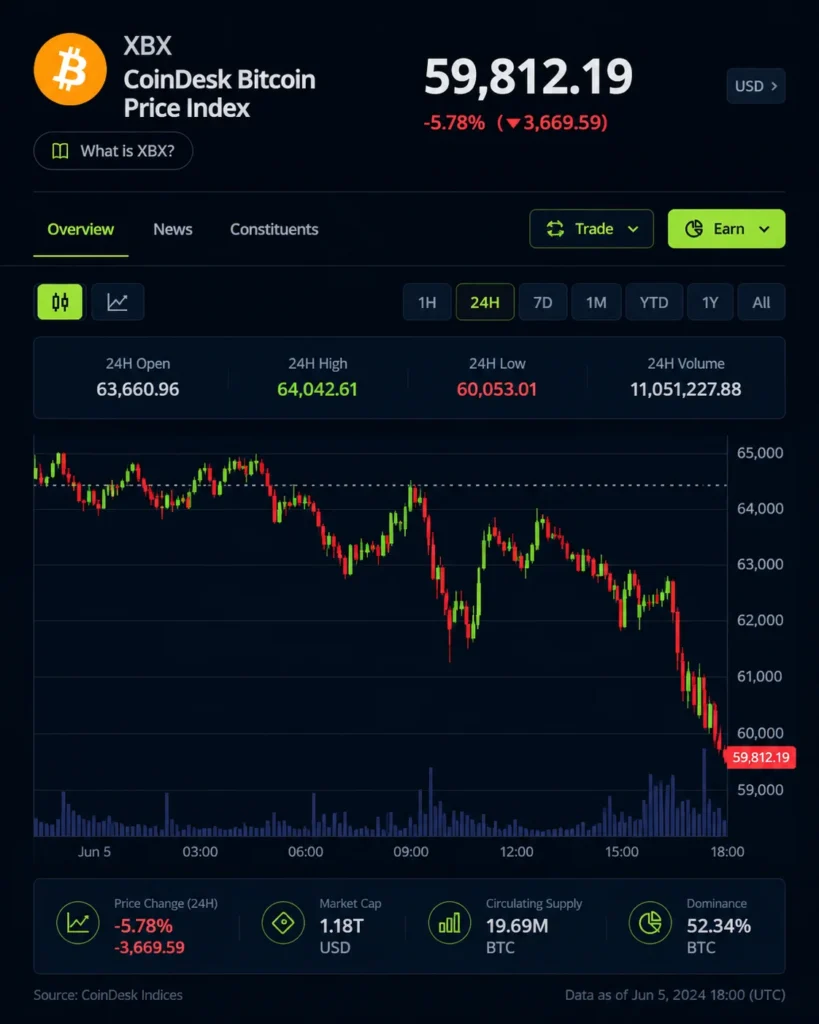
Bitcoin, the world’s largest cryptocurrency, has dropped below the psychologically important $60,000 level for the first time since October 2024. The latest decline marks one of the sharpest weekly drops in recent months and has sparked fresh debate about the future direction of the digital asset market.
The fall comes after several powerful market forces converged at the same time. Major investors are reducing exposure, Bitcoin exchange-traded funds (ETFs) are seeing money flow out, artificial intelligence stocks are attracting investor attention, and growing concerns about interest rates are weighing on risk assets globally.
As uncertainty spreads through financial markets, many investors are asking a simple question:
Is this merely another temporary setback for Bitcoin, or is the crypto market entering a new phase?
Bitcoin’s Sharp Fall Shakes Investor Confidence
Bitcoin slipped below $60,000 during Friday trading, reaching its lowest level since October 2024.
The cryptocurrency has now lost nearly 20 percent of its value in just one week.
Even more striking is the broader picture.
Bitcoin is now more than 50 percent below its previous peak, which exceeded $126,000 during its powerful rally. Such a decline represents a significant loss of market value and has naturally triggered concerns among both institutional and retail investors.
While Bitcoin remains one of the most valuable digital assets in the world, the recent downturn serves as a reminder of the volatility that has always been part of the cryptocurrency market.
Why Did Bitcoin Suddenly Drop?
No single event caused the decline.
Instead, multiple factors came together to create a challenging environment for cryptocurrencies.
Market analysts point to three major reasons behind the latest weakness.
A Major Bitcoin Buyer Turned Into a Seller
One of the most closely watched developments involved Strategy, the company led by Bitcoin advocate Michael Saylor.
For years, Strategy became famous for aggressively accumulating Bitcoin and was often considered one of the largest corporate supporters of the cryptocurrency.
The company’s buying activity frequently boosted market confidence because investors viewed it as a sign of strong institutional demand.
However, reports suggesting that the company shifted from buying to selling created concern throughout the market.
When one of Bitcoin’s biggest supporters changes direction, investors naturally pay attention.
The move raised questions about whether other large holders might follow a similar path.
ETF Investors Are Pulling Money Out
Another major source of pressure has been Bitcoin ETF outflows.
When spot Bitcoin ETFs were first approved, many analysts believed they would create a new era of institutional investment.
For a time, that prediction appeared accurate.
Billions of dollars flowed into Bitcoin investment products, helping push prices higher.
Recently, however, the trend has reversed.
Investors have been withdrawing funds from Bitcoin ETFs, reducing demand for the cryptocurrency and creating additional selling pressure.
ETF flows are closely monitored because they often provide insight into broader investor sentiment.
When money leaves these funds, markets frequently interpret it as a sign of weakening confidence.
Artificial Intelligence Is Stealing the Spotlight
A less obvious but increasingly important factor is the growing popularity of artificial intelligence investments.
Throughout the past year, AI-related companies have become some of the hottest investments on Wall Street.
Technology giants, semiconductor manufacturers, and AI software companies have attracted enormous amounts of investor capital.
As a result, some investors who previously allocated money to cryptocurrencies are now shifting funds toward AI opportunities.
This movement of capital has reduced demand for speculative assets such as Bitcoin.
Financial markets often experience these shifts.
When one sector becomes particularly attractive, investors frequently move money away from other assets to capture new opportunities.
At the moment, artificial intelligence appears to be winning that competition.
Interest Rate Fears Return to the Market
Another important factor behind Bitcoin’s decline involves monetary policy.
Recent economic data from the United States has shown stronger-than-expected inflation and labor market conditions.
As a result, investors are rethinking expectations regarding future interest rates.
Earlier in the year, many believed central banks would begin lowering rates.
Now, some market participants are discussing the possibility of future rate increases instead.
Why does this matter?
Higher interest rates generally reduce demand for riskier investments.
When safer assets such as government bonds offer attractive returns, investors become less willing to take risks in highly volatile markets.
Bitcoin often reacts negatively when interest-rate expectations move higher.
The recent shift in sentiment has therefore added additional pressure on cryptocurrencies.
The Reality of Crypto Investing
Many new investors enter the cryptocurrency market during periods of excitement.
Social media stories, headlines about massive gains, and predictions of endless growth often attract fresh participants.
However, experienced investors understand that markets rarely move in one direction forever.
Bitcoin has experienced multiple major declines throughout its history.
Some of these corrections exceeded 50 percent before prices eventually recovered.
This does not guarantee future recoveries, but it demonstrates that volatility has always been part of the asset’s journey.
The latest decline serves as a reminder that cryptocurrency investing carries significant risks alongside potential rewards.
New Security Concerns Add More Uncertainty
As if market pressures were not enough, the crypto sector is also facing fresh questions about security.
Recent discussions surrounding artificial intelligence and quantum computing have sparked debate about the long-term resilience of blockchain systems.
While many experts believe Bitcoin remains secure, advancements in technology are encouraging researchers to explore potential vulnerabilities.
These concerns gained additional attention after privacy-focused cryptocurrency Zcash experienced a major decline following the discovery of a critical vulnerability reportedly identified with assistance from an advanced AI model.
The incident reignited discussions about how emerging technologies could impact digital assets in the future.
Although Bitcoin itself was not directly affected, the broader crypto market reacted nervously.
How Are Other Cryptocurrencies Performing?
Bitcoin’s decline has not occurred in isolation.
Historically, when Bitcoin experiences significant price movements, the rest of the cryptocurrency market often follows.
Many alternative cryptocurrencies have recorded even larger losses than Bitcoin over the past week.
Smaller digital assets generally carry higher risk and tend to experience greater volatility during market downturns.
As investor confidence weakens, traders often reduce exposure across the entire sector rather than focusing solely on Bitcoin.
This creates a ripple effect throughout the crypto ecosystem.
What Are Analysts Watching Next?
Market participants are now closely monitoring several key indicators.
ETF Flows
Will investors continue withdrawing money, or will demand return?
Federal Reserve Policy
Interest-rate expectations remain one of the most important drivers of risk assets.
Institutional Activity
Large buyers and sellers can significantly influence market direction.
Technology Developments
Security concerns involving AI and future computing technologies remain under discussion.
Investor Sentiment
Market psychology often plays a major role in cryptocurrency price movements.
The answers to these questions may determine whether Bitcoin stabilizes or faces additional downside pressure.
Could Bitcoin Recover Again?
Despite the recent decline, many long-term supporters remain optimistic.
Bitcoin has survived multiple market crashes, regulatory challenges, economic crises, and periods of intense skepticism throughout its history.
Supporters argue that the cryptocurrency’s limited supply, global adoption, and growing role in digital finance continue to provide a strong foundation.
Critics, however, believe increasing regulation, competition from other technologies, and changing investor preferences could limit future growth.
The truth may lie somewhere in between.
Like any financial asset, Bitcoin’s future will depend on a combination of economic conditions, technological developments, regulation, and investor confidence.
Looking Ahead
The latest fall below $60,000 represents an important moment for the cryptocurrency market.
It highlights how quickly sentiment can change and how multiple economic forces can combine to influence asset prices.
For some investors, the decline may be viewed as a buying opportunity.
For others, it serves as a reminder to approach volatile markets with caution.
What happens next remains uncertain.
However, one thing is clear: Bitcoin continues to capture global attention, and every major move—whether upward or downward—remains a significant event in the world of finance.
As markets digest new economic data and investors reassess risk, the coming weeks could prove crucial in determining the next chapter of Bitcoin’s story.
Source:
CNBC, Bloomberg, Reuters, CoinDesk, CoinTelegraph, Financial Times, Yahoo Finance, MarketWatch, and cryptocurrency market data providers reporting on Bitcoin’s decline below $60,000 and related market developments.
Our audience means everything to us.
Have feedback or suggestions to make us better? We’re always listening—feel free to get in touch with us at truthora2026@gmail.com









Leave a Comment