

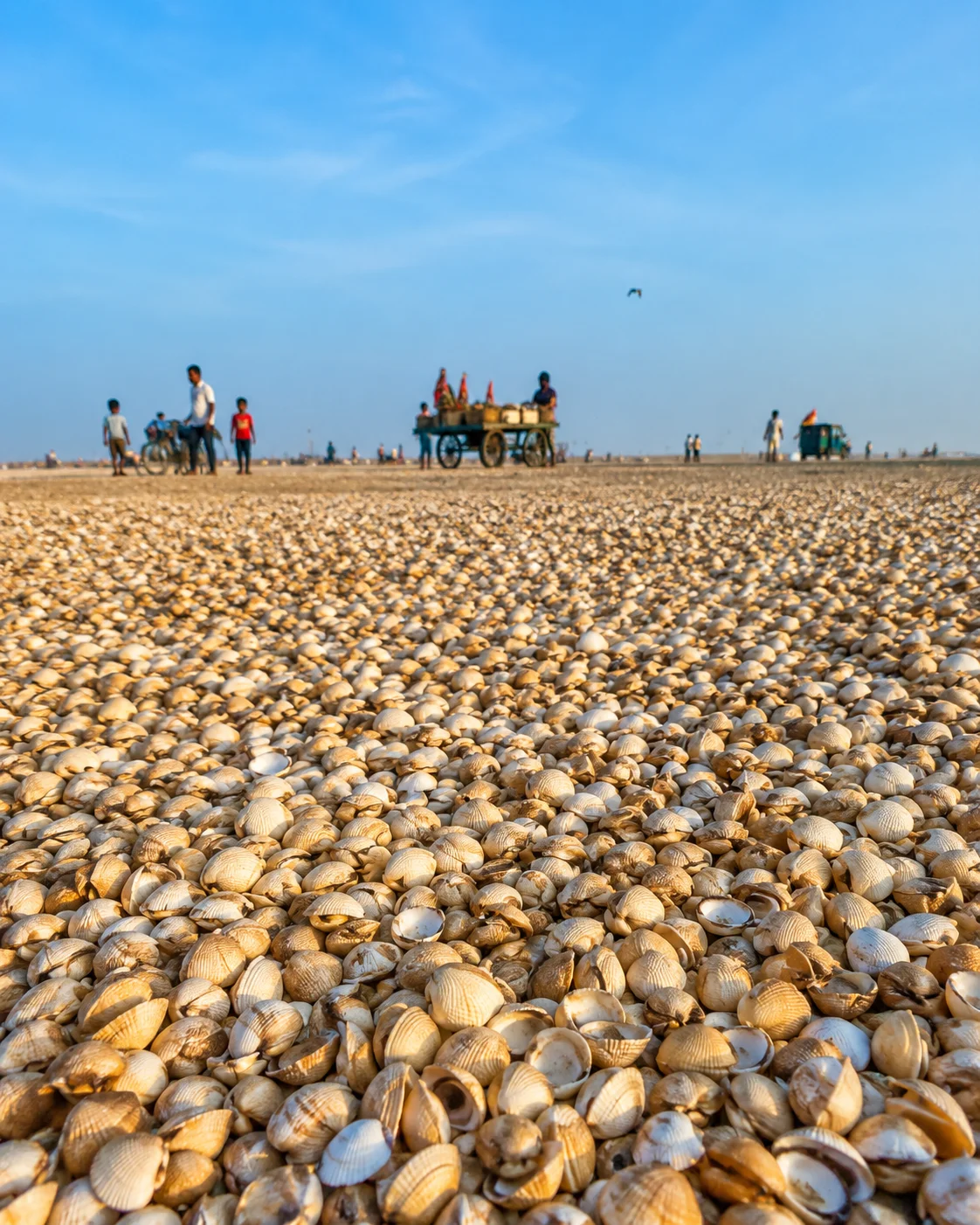
Every year, as summer approaches its peak and the monsoon season draws closer, Karachi’s beaches experience a fascinating transformation. Thousands — and sometimes millions — of seashells appear along the shoreline, creating a breathtaking scene that captures the attention of beachgoers, photographers, and social media users alike.
But why does this happen?
Is it a sign of climate change? Is marine life in danger? Or is it simply one of nature’s seasonal wonders?
Let’s explore the real story behind this unique coastal phenomenon.
A Spectacle Karachi Witnesses Almost Every Year
Visitors to Clifton, Sea View, and other coastal areas of Karachi have once again reported seeing large stretches of beach covered with white, yellow, and cream-colored shells.
For many residents, the sight may seem unusual. However, fishermen and marine experts say this is not a new occurrence. Historical reports show that similar events have been observed multiple times over the past two decades.
Local fishing communities even have a traditional name for the phenomenon and consider it a natural sign that the monsoon season is approaching.
What Causes So Many Seashells to Wash Ashore?
The answer lies deep beneath the waters of the Arabian Sea.
According to marine researchers, powerful southwest monsoon winds begin affecting the region around June. These winds push warm surface water away from the coastline and pull colder water upward from the ocean depths.
Scientists refer to this process as “upwelling.”
While this movement of water is essential for ocean ecosystems, it also brings oxygen-poor water closer to the seabed. Many shellfish species living on the ocean floor struggle to survive in such conditions.
As a result, empty shells are carried toward the coast by strong waves and currents, eventually accumulating on Karachi’s beaches.
Nature’s Annual Reminder of the Monsoon
Experts say the appearance of seashells is closely connected to the arrival of the monsoon.
Research on the Arabian Sea has shown that low-oxygen water typically reaches coastal areas between June and November — the same period when the largest concentrations of seashells are observed along Karachi’s shoreline.
This explains why residents often witness the phenomenon during the early weeks of the monsoon season.
In many ways, the shells act as a natural indicator that seasonal ocean conditions are changing.
Why Are There More Shells This Year?
This is where the story becomes even more interesting.
Several fishermen and coastal observers have noted that the number of seashells appearing in 2026 seems noticeably higher than in previous years.
Climate and marine experts believe rising sea temperatures may be one possible factor.
Recent marine heatwave advisories issued for parts of the Arabian Sea have highlighted unusually warm ocean surface temperatures. While scientists are still studying the long-term effects, warmer waters can alter oxygen levels and place additional stress on marine ecosystems.
Although researchers have not reached a final conclusion, some experts suggest these changing conditions could be contributing to larger shell deposits along the coast.
Is Climate Change Responsible?
The honest answer is: partially, but not entirely.
The seashell phenomenon itself is a natural event that has been documented for decades. Reports from previous years show that large shell accumulations occurred long before climate change became a major public discussion.
However, scientists are investigating whether rising ocean temperatures, pollution, and changing weather patterns may be increasing the scale of the phenomenon in certain years.
This means the event is natural, but environmental changes could be influencing its intensity.
What Happens to All These Seashells?
Interestingly, the shells do not simply remain on the beach.
Many coastal families collect them and use them to earn a living. After cleaning and processing, the shells are transformed into decorative products such as:
- Jewelry
- Keychains
- Photo frames
- Flower pots
- Home décor items
- Souvenirs for tourists
These handmade products are sold in local markets and provide income for numerous families living near the coastline.
Scientists Are Finding New Uses for Seashells
Beyond handicrafts, researchers are discovering valuable industrial applications for seashells.
Studies have found that processed seashells can be converted into bio-calcium carbonate, a material that can strengthen certain types of plastics and industrial products.
This means what many people see as beach waste could actually become an environmentally friendly resource for future manufacturing.
The Bottom Line
The annual appearance of seashells on Karachi’s beaches is one of nature’s most fascinating seasonal events. While the sight may seem alarming at first, experts say it is largely linked to monsoon-driven ocean processes that have been occurring for generations.
At the same time, scientists continue to monitor how climate change, marine heatwaves, and pollution may be influencing the scale of the phenomenon.
So the next time you walk along Karachi’s coastline and hear the crunch of shells beneath your feet, remember — you are witnessing a natural event shaped by the powerful forces of the Arabian Sea.
Source:
Dawn, Express Tribune, Aaj News, iVerify Pakistan, Journal of Sea Research, Deep-Sea Research Studies
Our audience means everything to us.
Have feedback or suggestions to make us better? We’re always listening—feel free to get in touch with us at truthora2026@gmail.com







Leave a Comment