

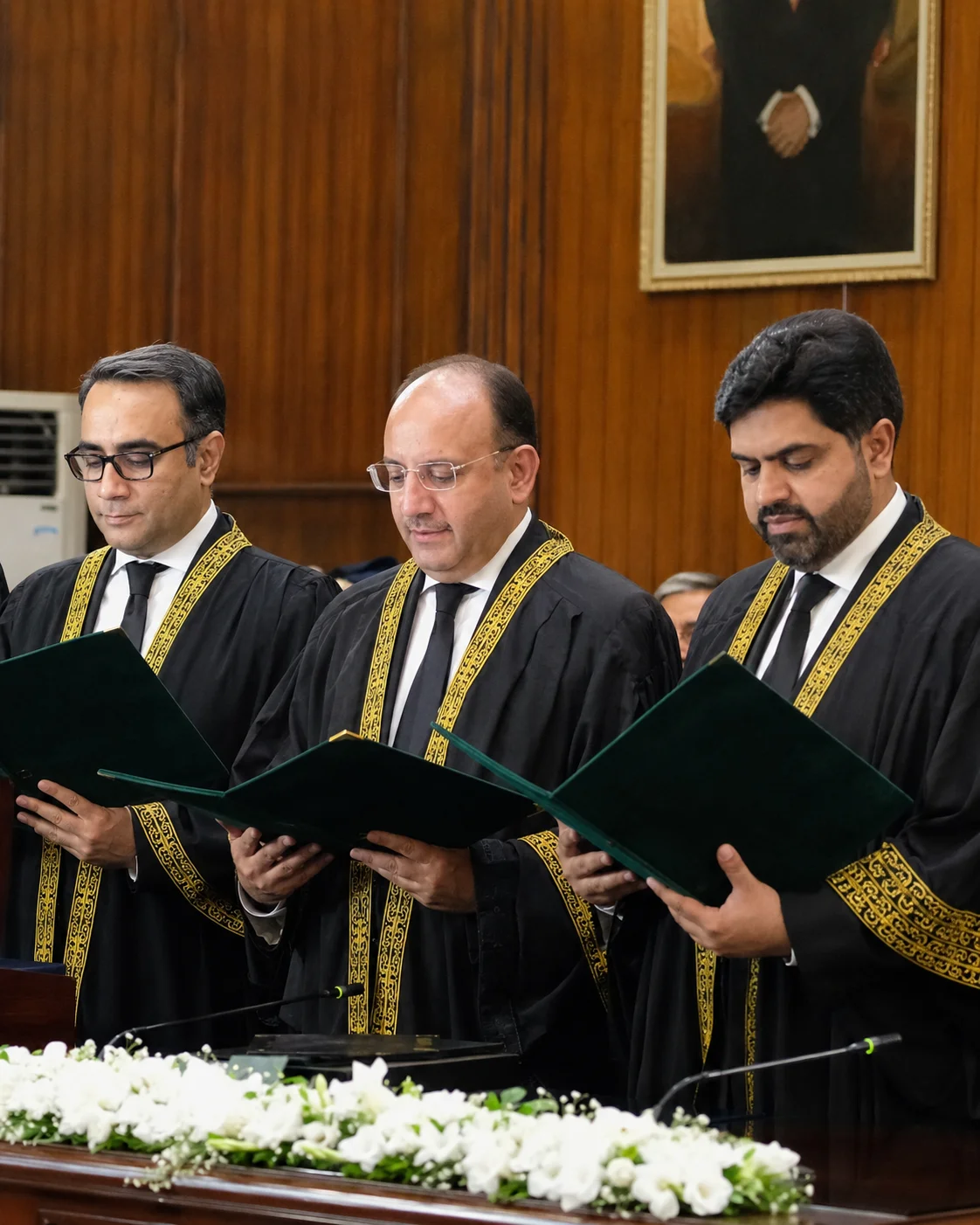
Three newly appointed IHC judges have taken oath at the Islamabad High Court, increasing the court’s strength to 10 judges, while three positions remain vacant. Chief Justice Sardar Mohammad Sarfraz Dogar administered the oath to Justice Ayyaz Shaukat, Justice Umair Majeed Malik and Justice Shahrukh Arjumand during a ceremony in Islamabad on Tuesday.
The appointments add legal experience in tax, banking, commercial, legislative and judicial matters to the Islamabad High Court. The remaining three vacancies are expected to be filled through transfers in accordance with a decision of the Judicial Commission of Pakistan (JCP).
The appointments also include a notable development for Khyber Pakhtunkhwa’s Upper Dir district, as Justice Shahrukh Arjumand becomes the first judge from the remote district to be elevated to a high court.
IHC judges strength rises to 10
The oath-taking ceremony marks an expansion of the Islamabad High Court’s judicial strength.
With the addition of Justice Ayyaz Shaukat, Justice Umair Majeed Malik and Justice Shahrukh Arjumand, the number of serving judges at the high court has risen to 10.
Three seats are still vacant. According to the information provided, those positions are expected to be filled through transfers following the JCP’s decision.
The filling of judicial vacancies is important for the functioning of a high court, where judges handle constitutional petitions, civil and commercial disputes, taxation matters and other cases falling within its jurisdiction.
The latest appointments bring different areas of professional and judicial experience to the bench.
Justice Ayyaz Shaukat brings tax and commercial expertise
Justice Ayyaz Shaukat has a professional background covering taxation, banking, corporate matters and commercial litigation.
Before his elevation to the Islamabad High Court, he served as the Advocate General for Islamabad. His legal career has included representation before superior courts in complex constitutional, corporate and commercial disputes.
His experience extends to public law as well as commercial litigation, areas that frequently generate significant legal proceedings before superior courts.
In March this year, Shaukat was also appointed chairman of the Pakistan Social Media Protection and Regulatory Authority.
His appointment to the IHC bench brings experience from both private legal practice and public office.
The range of matters in which he has worked includes tax and banking disputes, corporate litigation and constitutional cases.
Justice Umair Majeed Malik joins IHC bench
Justice Umair Majeed Malik has also joined the Islamabad High Court with experience in legislative drafting and specialised legal fields.
His professional career includes a period as a legal consultant with the National Accountability Bureau, where he served from 2002 to 2005.
He has also worked in the oil and gas sector, dealing with legal and regulatory matters related to petroleum laws, policies and rules.
His experience in that sector included work involving gas sale agreements, employment and labour laws, procurement contracts and regulatory frameworks.
Malik has additionally advised the construction sector on relevant legislation, regulations, rules and bylaws.
His work has included preparing and reviewing construction-related agreements and providing legal opinions on issues affecting the industry.
The breadth of his advisory and drafting experience adds another specialised legal background to the IHC bench.
Justice Shahrukh Arjumand makes history for Upper Dir
The appointment of Justice Shahrukh Arjumand carries particular significance for the legal community in Upper Dir.
Arjumand is from Upper Dir district in Khyber Pakhtunkhwa and is described as the first judge from the district to be elevated to any high court.
He completed his LLB from the University of Peshawar before entering the judicial service.
His judicial career began in 2003 when he joined the judiciary as a civil judge.
He later progressed through the judicial hierarchy and was promoted to the position of sessions judge in 2017.
His elevation to the Islamabad High Court represents a significant step in his judicial career and gives Upper Dir representation at the high court level.
The development is also notable for a district that has historically had limited representation in Pakistan’s superior judiciary.
Judicial Commission expected to fill remaining vacancies
Although the latest appointments have increased the IHC’s strength, three positions remain vacant.
The remaining seats are expected to be filled through transfers in line with a decision of the Judicial Commission of Pakistan.
The JCP plays a central role in the appointment process for judges of Pakistan’s superior courts under the constitutional framework.
The transfers expected for the remaining positions would further increase the number of judges available to hear cases at the Islamabad High Court.
No additional details about the judges expected to fill the three vacant positions were provided in the information available for this report.
Diverse legal experience added to the bench
The professional backgrounds of the three newly sworn-in judges cover several areas of law.
Justice Ayyaz Shaukat brings experience in taxation, banking, corporate and commercial litigation, as well as public law.
Justice Umair Majeed Malik has worked extensively in legislative drafting, regulatory matters and legal advisory roles, particularly in sectors such as oil and gas and construction.
Justice Shahrukh Arjumand, meanwhile, has spent much of his career within the judicial system, progressing from civil judge to sessions judge before his elevation to the high court.
The combination gives the IHC bench experience spanning judicial service, litigation, public law, commercial matters and regulatory work.
High courts regularly deal with cases involving a wide range of legal questions, making professional diversity among judges relevant to the court’s overall workload.
What the appointments mean for Islamabad High Court
The expansion of the IHC bench comes as the court continues to deal with a broad range of constitutional and legal matters.
The Islamabad High Court has jurisdiction over the federal capital and hears cases involving government departments, constitutional questions, civil disputes and other matters within its legal authority.
Increasing the number of serving judges can provide additional judicial capacity, although the overall effect depends on factors including case filings, workload, court scheduling and the availability of supporting judicial infrastructure.
The three appointments therefore represent a procedural development in strengthening the court’s bench rather than an immediate guarantee of faster disposal of cases.
The expected filling of the remaining three vacancies would further alter the court’s judicial strength once those appointments or transfers are completed.
Appointment process remains constitutionally governed
Appointments to Pakistan’s superior judiciary take place through a constitutionally established process involving the Judicial Commission of Pakistan and other relevant institutions.
The latest appointments follow that established framework.
The oath administered by Chief Justice Sardar Mohammad Sarfraz Dogar formally marks the assumption of judicial office by the three newly appointed judges.
Their subsequent responsibilities will include hearing and deciding cases within the Islamabad High Court’s jurisdiction.
As members of the superior judiciary, they will exercise judicial powers independently within the constitutional and legal framework applicable to the court.
A notable milestone for Upper Dir
Among the three appointments, Justice Shahrukh Arjumand’s elevation is particularly notable for the legal community in Upper Dir.
His career demonstrates a progression through Pakistan’s subordinate judicial system before reaching the high court.
Starting as a civil judge in 2003, he later became a sessions judge in 2017.
His elevation means that a judge originating from Upper Dir has now reached a high court for the first time, according to the information provided.
The development may be viewed as an important milestone in the representation of the district within the superior judiciary.
IHC now has 10 judges, with three seats open
The latest oath-taking ceremony brings the Islamabad High Court’s current judicial strength to 10.
Justice Ayyaz Shaukat, Justice Umair Majeed Malik and Justice Shahrukh Arjumand now join the court’s bench following their appointments.
Three additional positions remain vacant and are expected to be filled through transfers in accordance with the JCP’s decision.
For the Islamabad High Court, the next stage will therefore involve completing the process for those remaining positions.
The latest appointments add professional and judicial experience to the court while marking a significant career milestone for the newly elevated judges, particularly Justice Shahrukh Arjumand of Upper Dir.
Source:
- Information provided in the supplied news report concerning the oath-taking ceremony and appointments of the three Islamabad High Court judges.
- Judicial Commission of Pakistan — referenced in the supplied report regarding the filling of remaining vacancies.
Our audience means everything to us.
Have feedback or suggestions to make us better? We’re always listening—feel free to get in touch with us at editor@truthorahub.com




Leave a Comment