

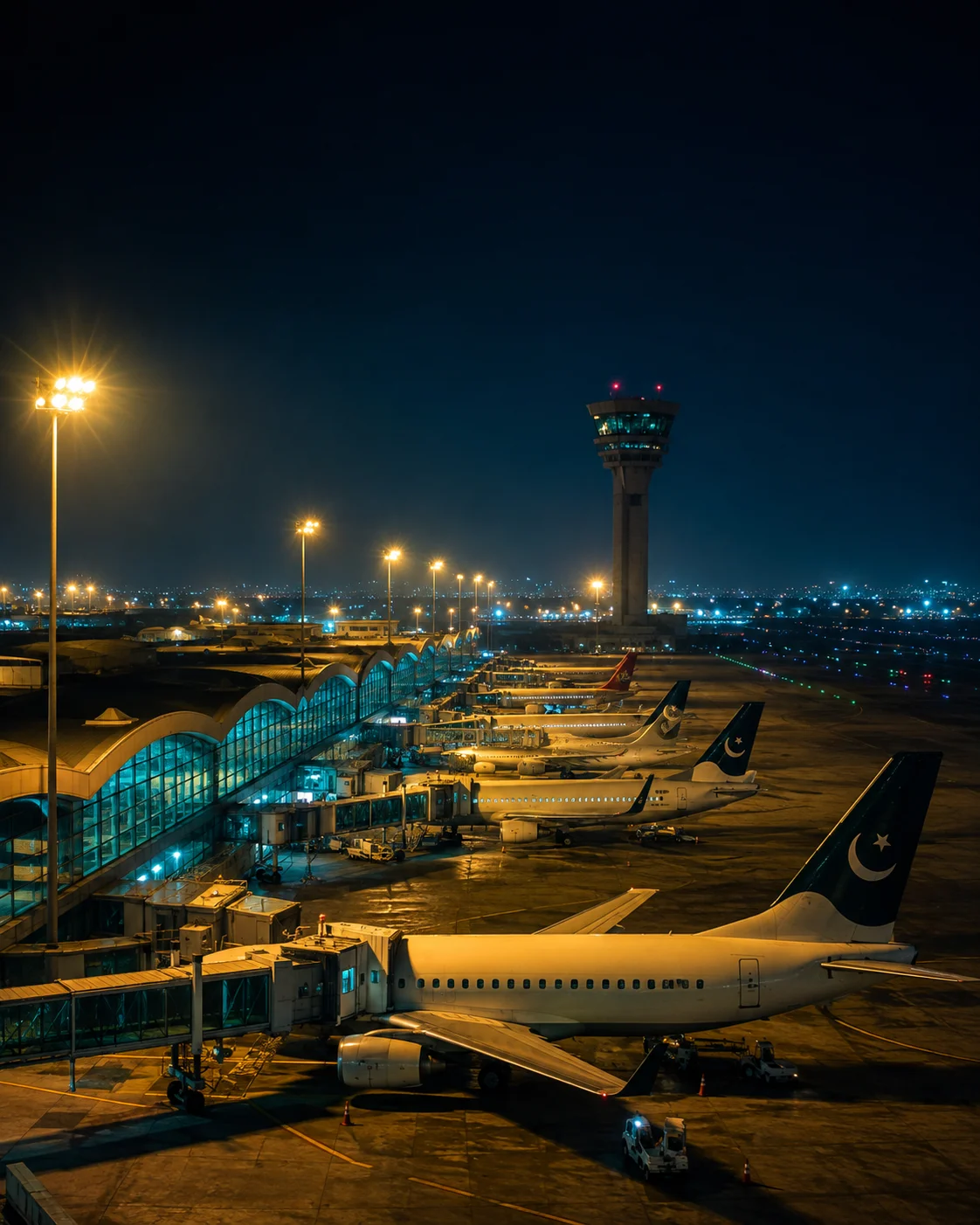
Pakistan’s airport outsourcing programme has moved forward with the Privatisation Commission approving a consortium led by EY-Parthenon as the top-ranked party to serve as financial adviser for the proposed outsourcing of Karachi and Lahore airports.
The decision covers Jinnah International Airport in Karachi and Allama Iqbal International Airport in Lahore. The Privatisation Commission’s board has also formed a negotiation committee to work out the Financial Advisory Services Agreement with the selected consortium.
The development is part of the government’s broader effort to bring private-sector participation into the management and operation of major public assets. The government has separately appointed the Asian Development Bank (ADB) as financial and transaction adviser for the planned outsourcing of Islamabad International Airport.
Pakistan airports outsourcing process advances
The latest decision represents another step in the government’s plans for the private-sector participation of Pakistan’s major international airports.
The Privatisation Commission had already invited technical and financial proposals for the appointment of a financial adviser for Jinnah International Airport and Allama Iqbal International Airport. The official commission record shows that the request was advertised in April 2026, followed by several extensions and addenda to the proposal process.
Under the government’s framework, a single financial adviser or consortium is being selected to advise on both airport transactions under one Financial Advisory Services Agreement.
The official request for proposals states that the adviser will be appointed under the Privatisation Commission’s applicable regulations and through a quality-and-cost-based selection process.
With the board now ranking the EY-Parthenon-led consortium first, the next stage will involve negotiations before the advisory agreement is finalised.
EY-Parthenon consortium to enter negotiations
The Privatisation Commission board has constituted a negotiation committee following the selection of the top-ranked interested party.
Its task will be to negotiate the terms of the Financial Advisory Services Agreement with the successful consortium.
The appointment of a financial adviser does not itself mean that Karachi or Lahore airport operations have been transferred to private ownership or management.
Instead, the adviser is expected to support the government through the transaction process, including work required to structure and evaluate the proposed private-sector participation.
The official request for proposals describes the transactions as the outsourcing or concession of the two airports and calls for one adviser to work on both transactions.
The final structure, commercial arrangements and terms of any eventual concession will depend on subsequent stages of the process.
Karachi and Lahore airports remain key assets
Jinnah International Airport in Karachi and Allama Iqbal International Airport in Lahore are among Pakistan’s most important aviation facilities.
Karachi serves the country’s largest commercial city and an important centre for trade, industry and international business. Lahore’s airport serves Punjab’s capital and one of Pakistan’s largest urban and economic centres.
The government’s decision to pursue private-sector participation at both airports reflects its wider plan to improve the management and performance of major aviation infrastructure.
In an earlier policy decision, the Privatisation Commission said the government was considering different models, including management contracts and long-term commercial concessions, for Islamabad, Karachi and Lahore airports. The stated objectives include improving efficiency and service delivery, increasing revenue generation, upgrading infrastructure and attracting domestic and international private investment.
The exact operating model for Karachi and Lahore will become clearer as the advisory and transaction process progresses.
Islamabad airport follows a separate track
The Karachi and Lahore process is separate from the outsourcing programme for Islamabad International Airport, although all three airports are part of the government’s broader privatisation strategy.
Last month, the Privatisation Commission appointed the Asian Development Bank as financial adviser for the outsourcing of Islamabad International Airport. The commission’s latest information shows that the ADB signed a Financial Advisory Services Agreement with the government in July 2026.
The Islamabad transaction is being pursued through a long-term concession model. The government has said it wants the airport’s operations to be transferred to a qualified private-sector operator through a transparent and competitive process.
This means Pakistan is currently progressing with separate advisory arrangements for Islamabad and the two airports in Karachi and Lahore.
Government also moves on power distribution companies
The Privatisation Commission’s latest board meeting also considered the proposed privatisation of two electricity distribution companies: Lahore Electric Supply Company (Lesco) and Multan Electric Power Company (Mepco).
The two companies have been identified as the fourth batch of distribution companies, or Discos, selected for the government’s privatisation programme.
The commission said the transactions are considered major assignments and therefore require the appointment of financial advisers under the applicable rules.
Following the board’s decision, the process for selecting financial advisers for Lesco and Mepco is expected to begin.
The government is pursuing the privatisation of several Discos in phases rather than attempting to complete all transactions simultaneously.
The Privatisation Commission’s official records show that the government has already been seeking investor participation for the first batch, which includes Faisalabad Electric Supply Company (Fesco), Gujranwala Electric Power Company (Gepco) and Islamabad Electric Supply Company (Iesco).
Investor interest in power distribution sector
The Disco privatisation programme has already attracted interest from private investors.
According to the information provided in the report, Fesco, the first company in the initial batch, has received expressions of interest from around a dozen local and international investors.
The commission is reviewing those submissions as part of the ongoing process.
The government has also set separate deadlines for expressions of interest relating to other companies in the first batch, meaning the privatisation of the power distribution sector is progressing through multiple stages.
The commission has described the process as one intended to encourage private-sector participation while improving efficiency and service delivery in the electricity distribution system.
What the airport decision means
The appointment of a financial adviser is an important procedural step, but it is not the final stage of airport outsourcing.
The adviser will help the government evaluate and structure the proposed transactions before private-sector participation can be finalised.
For Karachi and Lahore airports, the next immediate stage is negotiation of the Financial Advisory Services Agreement with the EY-Parthenon-led consortium.
Only after the advisory and transaction stages are completed will the government be in a position to proceed toward selecting a private-sector operator under the applicable framework.
The process is therefore still underway, and the final terms, duration and commercial structure of any concession or outsourcing arrangement have not been established in the information currently available.
Broader privatisation programme continues
The latest airport decision comes as Pakistan continues to advance a wider privatisation programme covering aviation, energy and other public-sector assets.
The government has been using financial advisers and transaction advisers to help structure major transactions and attract potential domestic and international investors.
The Privatisation Commission’s official programme includes airport outsourcing alongside the privatisation of power distribution companies and other state-owned entities. Its published documents show that the Karachi and Lahore airport advisory process was formally launched in April 2026.
For the aviation sector, the government’s stated objectives include better operational efficiency, improved passenger services, infrastructure upgrades and stronger revenue performance.
For the power sector, the focus is on bringing private investment and management expertise into distribution companies.
The selection of the EY-Parthenon-led consortium therefore marks a further procedural development rather than completion of the airport outsourcing process.
Source:
- Dawn — report on the Privatisation Commission’s approval of the financial adviser for Karachi and Lahore airports, as provided in the source material.
- Privatisation Commission, Government of Pakistan — official information on the financial adviser procurement process for Jinnah International Airport and Allama Iqbal International Airport.
- Privatisation Commission, Government of Pakistan — official updates on Islamabad International Airport outsourcing and the ADB’s appointment.
- Privatisation Commission, Government of Pakistan — official information on the government’s airport privatisation programme.
- Privatisation Commission, Government of Pakistan — official information on the DISCO privatisation programme.
Our audience means everything to us.
Have feedback or suggestions to make us better? We’re always listening—feel free to get in touch with us at editor@truthorahub.com






Leave a Comment