

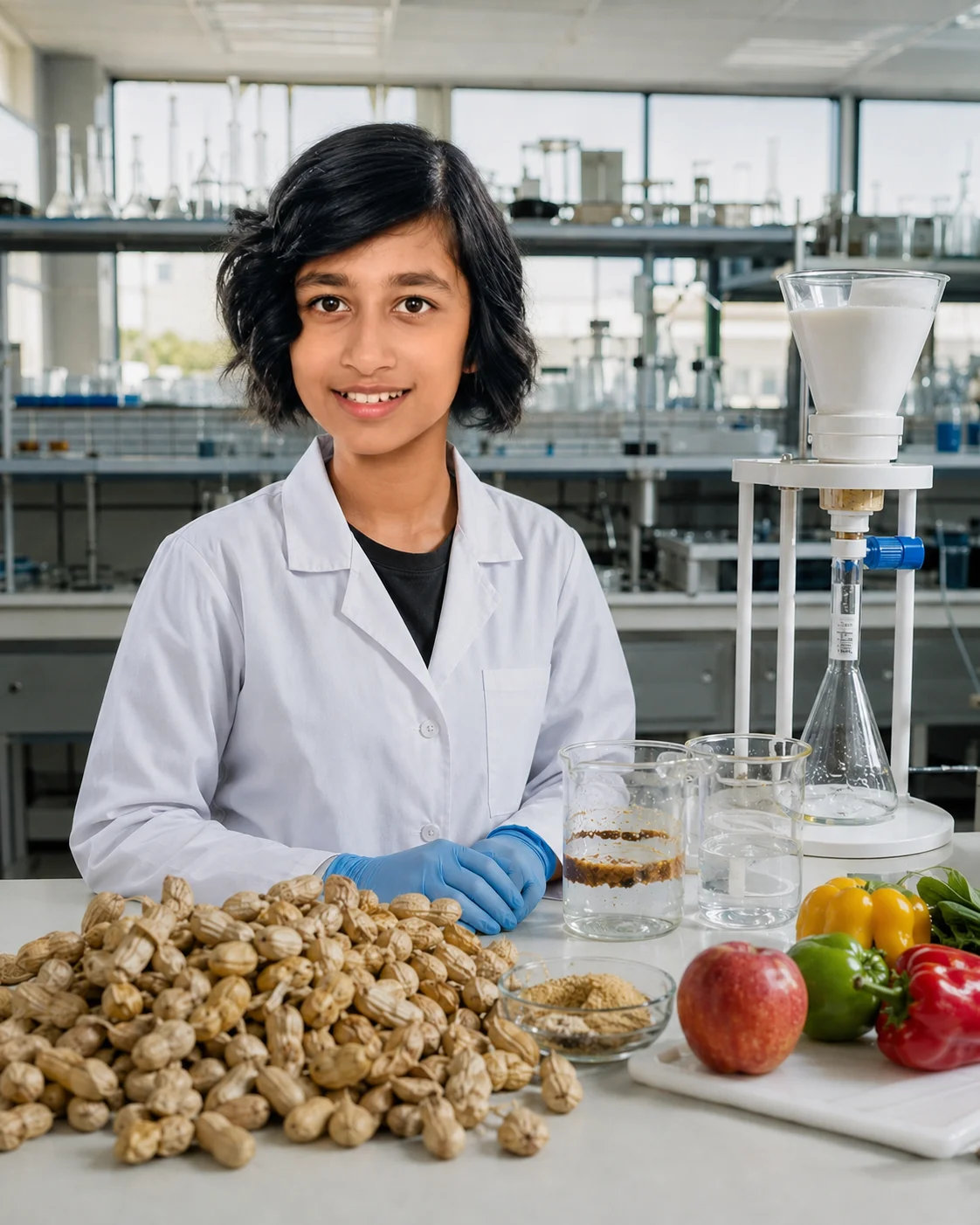
Arika Kundu Develops Peanut Shell Method to Reduce Pesticides
A 13-year-old student from Minnesota has gained national recognition after developing an innovative method that uses discarded peanut shells to help reduce pesticide residues on fresh fruits and vegetables. Arika Kundu, an Indian-American seventh-grade student at Minnetonka Middle School East, has been named one of the top 10 finalists in the 2026 3M Young Scientist Challenge for her environmentally friendly food safety project.
Her research combines sustainable waste management with practical food safety, offering a low-cost approach that could help reduce chemical residues on produce while making productive use of agricultural waste.
A Student Innovation Focused on Food Safety
Arika Kundu’s project is titled “LIGNEX – A Novel Biosorption-Based Approach That Uses Agricultural Waste Material to Eliminate Pesticide Residues From Fresh Produce.”
The project addresses a common concern faced by consumers around the world. While washing fruits and vegetables removes dirt and some contaminants, pesticide residues can often remain on their surfaces.
Seeking an affordable and environmentally responsible solution, Arika explored whether agricultural waste could play a useful role in improving produce safety.
Instead of relying on expensive filtration systems or chemical treatments, she turned to a material that is usually thrown away after harvesting: peanut shells.
How the Peanut Shell Method Works
Using Biosorption to Capture Pesticides
Arika’s project is based on biosorption, a natural process in which biological materials attract and bind certain chemicals.
She developed a process that converts discarded peanut shells into a material capable of trapping pesticide residues from fruits and vegetables.
When fresh produce comes into contact with the treated peanut-shell material, it acts as a natural adsorbent, helping capture pesticide residues that may remain on the surface.
The approach highlights how agricultural by-products can be repurposed into useful materials instead of becoming waste.
Although the project is still in the research and competition stage, it demonstrates how sustainable materials may contribute to practical food safety solutions in the future.
Why the Research Matters
Food safety remains an important public health issue in many countries.
Consumers routinely wash fruits and vegetables before eating them, but studies have shown that some pesticide residues can remain even after rinsing with water.
Researchers worldwide continue to explore safer, affordable and environmentally friendly methods to reduce these residues without affecting food quality.
Arika’s project contributes to this broader area of research by proposing a biosorption-based approach using waste materials that are widely available.
If further developed and validated, similar technologies could potentially support more sustainable produce cleaning methods while reducing agricultural waste.
Recognition in the 2026 3M Young Scientist Challenge
Arika’s work has earned her a place among the top 10 finalists in the 2026 3M Young Scientist Challenge, one of the leading science competitions for middle school students in the United States.
The competition encourages students to create science-driven solutions for real-world problems across areas such as health, sustainability, engineering and environmental protection.
As part of the competition, each finalist is paired with a 3M scientist who serves as a mentor during the summer.
Working alongside the mentor, students refine their ideas, improve their research and prepare for the competition’s final presentations.
The championship round is scheduled for October 2026, where finalists will compete for the $25,000 grand prize and the title of “America’s Top Young Scientist.”
Arika Kundu’s Motivation
Speaking about her participation, Arika said she entered the competition with the goal of strengthening her innovation skills while developing a solution that could benefit people more broadly.
She said she hopes her idea can eventually become a practical product that people can use in everyday life.
Her project reflects a growing interest among young researchers in combining scientific research with sustainability and public health challenges.
Looking Beyond Food Safety
While her current project focuses on reducing pesticide residues, Arika has already set ambitious long-term career goals.
She said she hopes to become an astrobiologist, with a particular interest in computational biology, within the next 15 years.
According to Arika, she would like to contribute to research aimed at reducing radiation exposure during space travel.
Advances in this area could also have broader applications, including research related to cancer treatment, ageing and other scientific fields.
Her long-term vision demonstrates an interest in applying science to solve complex global challenges beyond her current project.
Young Scientists Driving Sustainable Innovation
Student-led scientific innovation continues to gain attention worldwide as schools and research competitions encourage young people to tackle real-world problems.
Projects involving renewable materials, waste reduction, clean technology and public health are becoming increasingly common among science competitions.
By transforming agricultural waste into a potentially useful resource, Arika’s research highlights how simple materials can inspire creative scientific solutions.
Although additional research and testing would be required before any large-scale commercial application, the project illustrates the potential of combining sustainability with scientific innovation.
What Happens Next
Over the coming months, Arika will continue refining her biosorption technology with guidance from a 3M scientist before presenting the project during the final stage of the competition in October.
The judges will evaluate finalists on scientific thinking, creativity, communication and the potential real-world impact of their inventions.
Regardless of the final results, Arika’s selection among the competition’s top finalists already marks a significant achievement and highlights the growing role young innovators can play in addressing environmental and public health challenges.
Source:
- 3M Young Scientist Challenge information provided in the source material
- Statements attributed to Arika Kundu provided in the source material
Our audience means everything to us.
Have feedback or suggestions to make us better? We’re always listening—feel free to get in touch with us at editor@truthorahub.com






Leave a Comment