

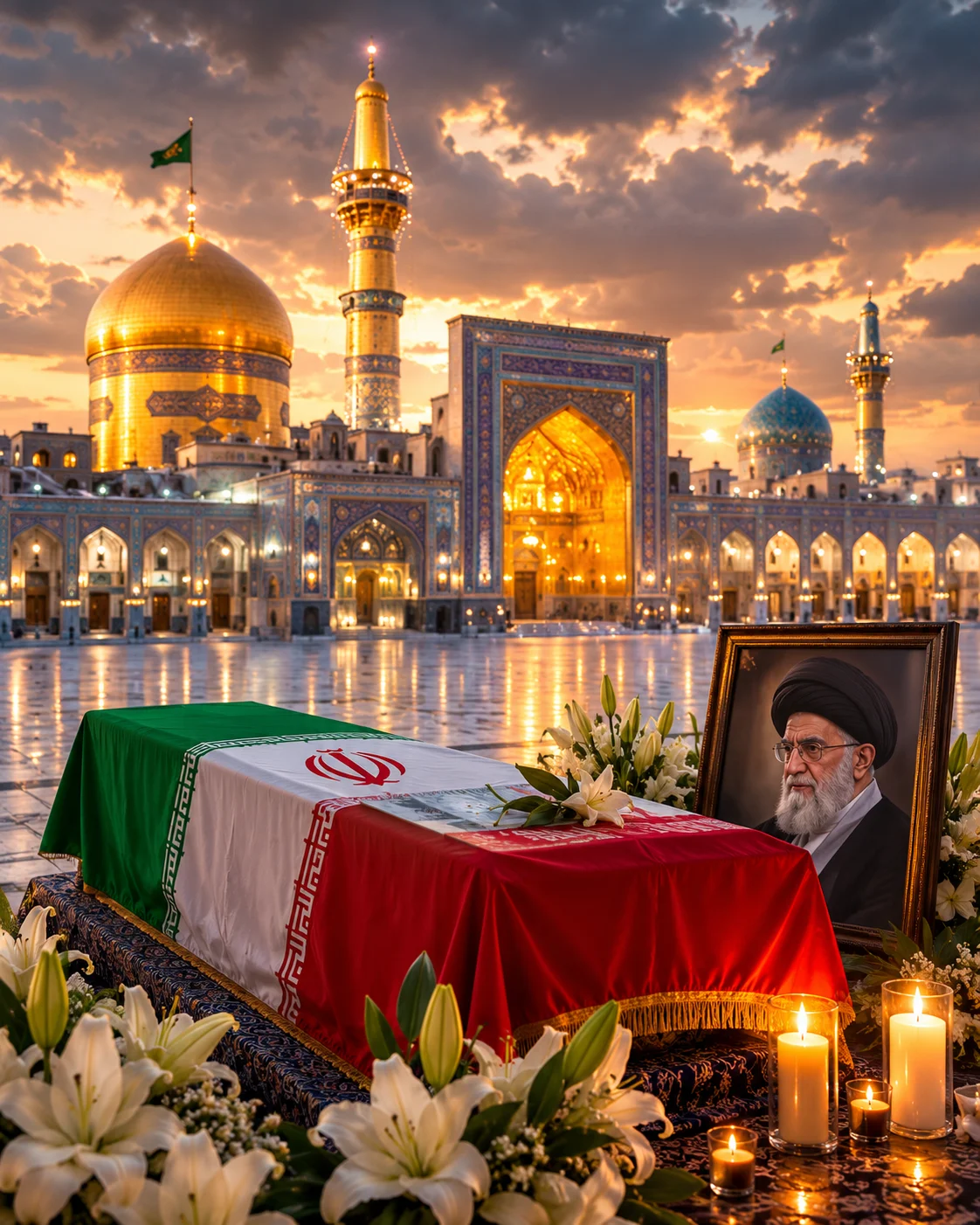
Ayatollah Ali Khamenei Buried in Mashhad After State Funeral
Ayatollah Ali Khamenei buried at the Shrine of Imam Reza in Mashhad has marked the conclusion of a week of state-organized mourning ceremonies across Iran and Iraq. According to Iranian state media, the burial took place early Friday after massive funeral processions drew thousands of mourners. The ceremonies come amid heightened regional tensions following renewed hostilities involving Iran and the United States after a temporary ceasefire.
Ayatollah Ali Khamenei Laid to Rest in Iran’s Holiest Shrine
Iranian state media reported that Ayatollah Ali Khamenei was buried at the Shrine of Imam Reza in the northeastern city of Mashhad, one of the country’s most significant religious sites.
The funeral procession moved through crowded streets as thousands of mourners gathered to pay their respects. Clerics dressed in traditional white turbans accompanied the vehicle carrying Khamenei’s coffin, while supporters waved Iranian flags and displayed photographs of the late leader.
The burial concluded several days of public mourning events that were held across major Iranian cities and religious centers in neighboring Iraq.
Funeral Ceremonies Draw Large Crowds
State-organized funeral processions began shortly after Khamenei’s reported death and continued throughout the week.
According to Iranian media, his remains were previously taken through Tehran, Qom, and the Iraqi shrine cities of Najaf and Karbala before arriving in Mashhad for the final burial ceremony.
Videos released by state media showed large crowds gathered inside and outside the shrine, with mourners holding candles, reciting prayers, and participating in funeral rituals.
As evening fell, the shrine complex filled with worshippers while funeral hymns and religious recitations were broadcast through loudspeakers.
Background to Khamenei’s Death
According to the information provided by Iranian authorities, Ayatollah Ali Khamenei was assassinated during the opening strikes of a conflict that reportedly began on February 28 involving the United States and Israel.
The conflict lasted for several months before both the United States and Iran agreed to a ceasefire last month.
The circumstances surrounding the assassination remain part of the broader regional conflict, which has significantly increased tensions across the Middle East.
Mojtaba Khamenei Remains Out of Public View
One of the most closely watched developments since the funeral has been the continued absence of Ayatollah Mojtaba Khamenei, who Iranian authorities say succeeded his father as supreme leader after a clerical assembly appointed him in early March.
He has not appeared publicly since the conflict began.
Although written statements have reportedly been issued in his name, no official photographs, videos, or recorded speeches have been released during this period.
According to senior sources in Tehran cited in the original report, Mojtaba Khamenei was reportedly injured during the attack that killed his father. Those reports claim he sustained serious injuries, although Iranian authorities have not publicly released detailed medical information.
The same sources said security concerns and ongoing recovery have limited his public appearances. These claims have not been independently verified.
Anti-US Slogans Heard During Funeral
During the funeral procession in Mashhad, crowds chanted slogans directed against the United States.
According to reports from the ceremony, some mourners also carried placards containing threats against U.S. President Donald Trump.
These slogans reflected public anger among sections of the crowd following Khamenei’s reported assassination.
The chants occurred alongside traditional mourning rituals and religious ceremonies held throughout the day.
Final Burial Ceremony at Imam Reza Shrine
As the procession reached the shrine, a helicopter transported Khamenei’s coffin over dense crowds for the final approach to the burial site.
His eldest son, Mostafa Khamenei, led the funeral prayer before the coffin, draped in the Iranian national flag, was carried into the shrine by mourners.
Iran’s official IRNA news agency later reported that the burial of Ayatollah Ali Khamenei and four family members who were reportedly killed alongside him had been completed.
Why the Burial Matters
The burial of Ayatollah Ali Khamenei represents a significant moment in Iran’s contemporary political and religious history.
As the country’s long-serving supreme leader, Khamenei held ultimate authority over Iran’s political, military, and religious institutions for decades.
His reported death and the succession of Mojtaba Khamenei come during a period of heightened geopolitical tensions involving Iran, the United States, and Israel.
The transition in leadership is expected to remain closely monitored by regional governments and the international community, particularly as questions remain regarding Iran’s future domestic and foreign policies.
The funeral ceremonies also demonstrated the symbolic importance of the Shrine of Imam Reza, one of the holiest sites in Shia Islam, which has historically served as the burial place of prominent religious figures.
Regional Situation Continues to Evolve
Although the funeral ceremonies have concluded, the broader regional situation remains uncertain.
The reported ceasefire between Iran and the United States has reduced direct military activity, but political tensions remain high.
Observers continue to monitor developments surrounding Iran’s leadership transition, regional diplomacy, and security conditions following months of conflict.
According to Iranian state media, the funeral events were intended to demonstrate national unity during a period of significant political change.
Source:
- Reuters
- IRNA (Islamic Republic News Agency)
Our audience means everything to us.
Have feedback or suggestions to make us better? We’re always listening—feel free to get in touch with us at editor@truthorahub.com





Leave a Comment