

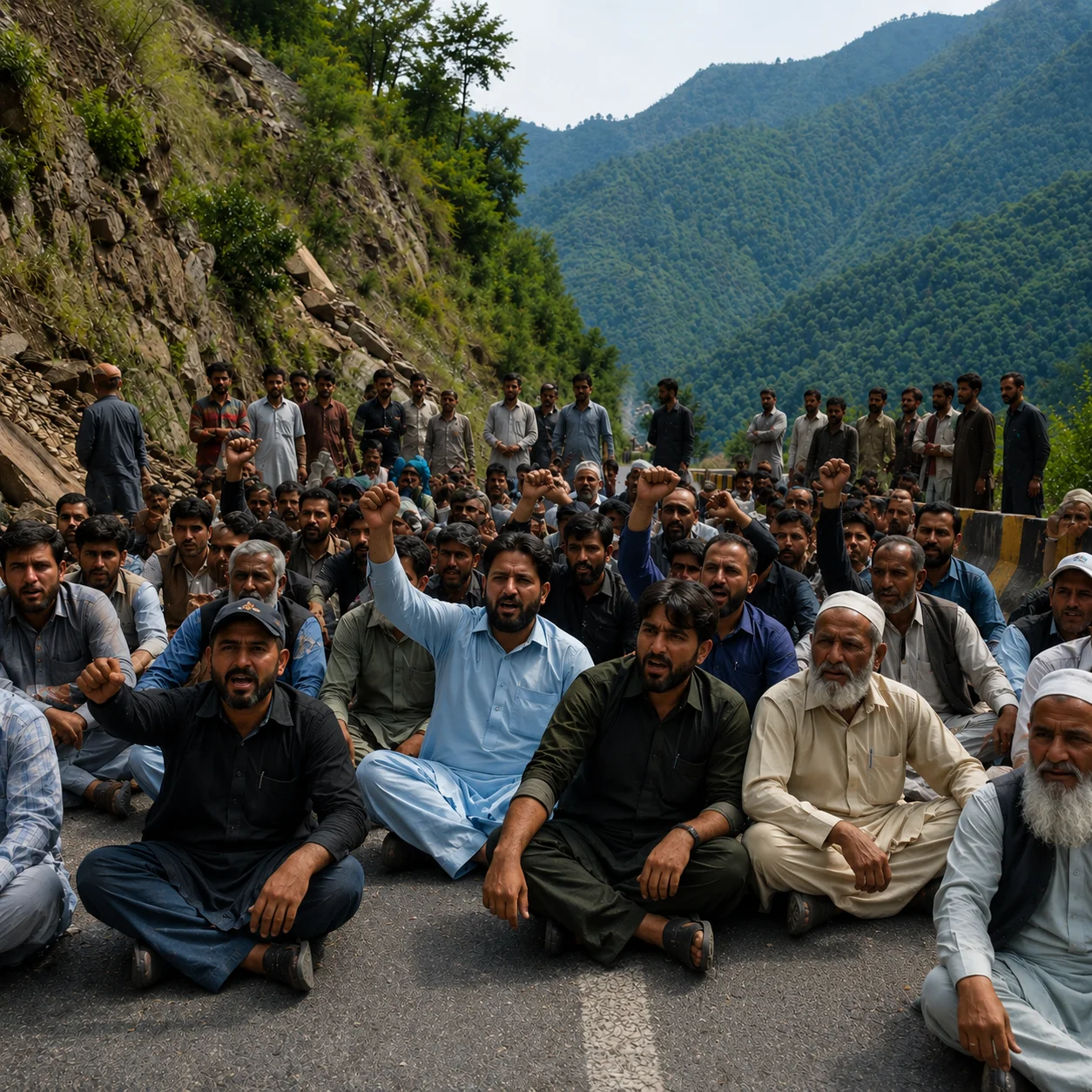
Businesses Closed, Roads Empty, and Workers Struggling as Tensions Continue in Pakistan-Administered Kashmir
For many people living in Pakistan-administered Kashmir, life has changed dramatically over the past two weeks. Streets that were once crowded with shoppers, transport vehicles, and daily wage workers have become unusually quiet as a region-wide shutdown continues following deadly protests.
The unrest has not only created political tensions but has also affected ordinary families, small businesses, laborers, students, and commuters. As authorities impose restrictions and protesters continue their demonstrations, one important question remains:
Who is paying the biggest price for this crisis?
The answer appears to be the people trying to earn a living and support their families.
What Triggered the Latest Unrest?
The current wave of protests began ahead of a June 9 strike called by the Joint Awami Action Committee (JAAC), a group that was recently banned by regional authorities.
The main issue revolves around the reservation of 12 seats in the upcoming July 27 legislative assembly elections. These seats are allocated to refugees originally displaced from Indian-administered Kashmir who now live in different parts of Pakistan.
Supporters of the protest movement argue that representation in the regional assembly should primarily belong to residents currently living in the territory. Authorities, however, maintain that the arrangement has constitutional and historical significance.
What started as political disagreement quickly escalated into one of the most serious periods of unrest seen in the region in recent years. Reports indicate that at least 24 people have lost their lives during the clashes, including civilians and police personnel, while many others have been injured. Hundreds of people have also been detained.
Why Are These 12 Seats So Controversial?
To understand the protests, it is important to understand the debate surrounding the reserved seats.
The seats are intended for refugees from Indian-administered Kashmir who settled in Pakistan after displacement linked to the Kashmir conflict. Supporters of the arrangement believe it preserves political representation for displaced Kashmiris and supports Pakistan’s long-standing position on the Kashmir dispute.
Critics, however, argue that elected representatives should come from communities currently living in the region and directly experiencing its economic and political challenges.
The disagreement has transformed from a constitutional debate into a wider discussion about governance, local representation, and regional autonomy.
The Human Cost Behind the Headlines
While political leaders and protesters continue to debate the future of the region, ordinary citizens are facing a very different reality.
In Muzaffarabad and other cities, commercial activity has slowed dramatically. Markets that normally remain busy throughout the day are operating at limited capacity or remain closed altogether.
For daily wage workers, every day without work means another day without income.
Many laborers depend entirely on daily earnings to purchase food and pay household expenses. Without regular business activity, thousands of workers have found themselves unable to earn even a basic income.
Small shop owners are also struggling. Restaurants, roadside vendors, transport operators, and service providers have all reported major disruptions as customers remain home and movement restrictions continue.
For people already dealing with rising living costs, the shutdown has created additional financial pressure.
Internet Blackouts and Communication Challenges
One of the most significant impacts of the crisis has been the restriction of internet services.
Authorities have suspended or limited internet access in parts of the region as part of security measures. While officials view such actions as necessary to maintain order, residents say the restrictions have created serious practical difficulties.
Modern businesses depend heavily on internet connectivity. Online payments, communication with customers, banking transactions, and remote work opportunities all become difficult when digital services are interrupted.
Students, freelancers, and entrepreneurs have also reported challenges in continuing their daily activities.
The internet restrictions have therefore expanded the impact of the unrest far beyond the streets where protests are taking place.
Banking Services and Fuel Supply Affected
The shutdown has also affected banking operations.
Several financial services have reportedly faced disruptions because of communication restrictions. Residents in some areas have struggled to access ATMs and complete routine banking transactions.
Fuel availability has also become a concern in certain locations as petrol stations remain affected by official restrictions and reduced transportation activity.
Together, these challenges create a chain reaction across the local economy. When banking slows and fuel supplies become difficult to access, businesses face additional obstacles in maintaining operations.
As a result, economic activity continues to decline while uncertainty grows.
Thousands Gather as Protests Continue
Despite the restrictions, protest activity has not completely disappeared.
Reports suggest that thousands of JAAC supporters remain gathered near Rawalakot and surrounding areas. Protest leaders continue to emphasize their demands regarding political representation and governance issues.
Meanwhile, authorities have increased security measures and maintained restrictions aimed at preventing further violence.
The situation remains delicate because both sides appear determined to defend their positions.
Analysts say the longer the standoff continues, the more difficult it may become to restore normal economic and social activity across the region.
A Wider Debate About Governance
Many observers believe the current crisis extends beyond the issue of reserved seats.
Over the past few years, various protest movements in the region have raised concerns about electricity prices, wheat subsidies, economic conditions, governance reforms, and local representation.
Some experts argue that the current unrest reflects deeper frustrations that have accumulated over time.
Others believe the dispute highlights competing views about how the region should be governed and represented politically.
Regardless of perspective, the events of recent weeks have demonstrated that political decisions can have immediate consequences for ordinary citizens.
Can Dialogue Help End the Crisis?
One question is increasingly being asked by residents:
Can negotiations provide a way forward?
Several political figures and local residents have called for dialogue between authorities and protest representatives.
Supporters of negotiations argue that discussions offer the best opportunity to reduce tensions, restore economic activity, and prevent further loss of life.
History shows that prolonged confrontations often leave lasting economic and social damage. Constructive engagement, many believe, may offer a more sustainable path toward stability.
However, reaching an agreement will likely require compromises from multiple sides.
For now, uncertainty continues to dominate the region.
What Happens Next?
The coming weeks could prove crucial for Pakistan-administered Kashmir.
With legislative elections scheduled for July 27 and public tensions remaining high, authorities face the challenge of maintaining order while addressing growing concerns among residents.
Businesses hope for a return to normal operations.
Workers hope for the opportunity to earn a living again.
Families hope for stability and peace.
Whether those hopes are realized may depend on how quickly dialogue, political solutions, and confidence-building measures can replace confrontation.
Until then, the shutdown remains a powerful reminder that political disputes often affect ordinary people far more than the headlines suggest.
Conclusion
The ongoing unrest in Pakistan-administered Kashmir is not only a political story—it is also a human story. Behind every closed shop, empty road, and silent marketplace are families facing uncertainty about their future.
As protests, restrictions, and political debates continue, the biggest challenge may be finding a solution that addresses both constitutional concerns and the everyday needs of the people who call the region home.
The coming days will determine whether the region moves toward reconciliation or experiences further disruption.
Source:
Reuters, Associated Press (AP), Al Jazeera
Our audience means everything to us.
Have feedback or suggestions to make us better? We’re always listening—feel free to get in touch with us at truthora2026@gmail.com






Leave a Comment